

“Will my child lose their visa if we get divorced?”
“Can my child continue living with me in Japan after the divorce?”
“Can a parent who does not have legal custody still renew their child’s residence status?”
For foreign families living in Japan, divorce can raise many concerns about their children’s residence status.
In particular, if a child is living in Japan under the “Dependent” (家族滞在) or “Long-Term Resident” (定住者) status of residence, changes in the family’s living arrangements after divorce may affect future applications for a change or extension of status.
The most important point is that a child’s residence status does not automatically become invalid simply because their parents get divorced.
However, the necessary procedures will depend on the child’s current status of residence and who will raise and financially support the child after the divorce.
In this article, an administrative scrivener specializing in immigration procedures explains the important points to consider when changing or renewing a foreign child’s residence status after their parents’ divorce.
- Does a Child’s Residence Status Automatically End When Their Parents Divorce?
- What Happens to a Child with “Dependent” Status When Their Parents Divorce?
- What Happens to the Child’s Residence Status When a Japanese National and a Foreign National Divorce?
- Can a Child with “Long-Term Resident” Status Continue Living in Japan After Their Parents Divorce?
- Does Child Custody Affect Residence Status After Divorce?
- Important Points When Changing or Renewing a Child’s Residence Status After Divorce
- Frequently Asked Questions
- Q1. Can My Child Continue Attending School in Japan After Our Divorce?
- Q2. If the Child Lives with the Mother and the Father Pays Child Support, Can the Child’s “Dependent” Status Be Renewed?
- Q3. If a Japanese Father and a Foreign Mother Divorce, Must Their Child Leave Japan?
- Q4. If the Foreign Mother Does Not Have Legal Custody After Divorce, Can She Still Live in Japan?
- Q5. Can My Child Renew Their Current Residence Status Without Changing It After Our Divorce?
- Conclusion: Helping Your Child Continue Living in Japan After Divorce
- Contact Us
- 044-379-8319
Does a Child’s Residence Status Automatically End When Their Parents Divorce?
First, it is important to understand that parents and children are each granted their own status of residence in Japan.
Therefore, a parent’s divorce does not automatically result in the cancellation of the child’s residence status.
However, many residence statuses granted to children are based on their family relationships or financial dependence on a parent.
As a result, a divorce may affect whether the child continues to meet the requirements for their current status.
The following table summarizes how divorce may affect different residence statuses.
| Child’s Nationality or Residence Status | Possible Impact of Divorce |
|---|---|
| Japanese nationality | No impact on residence status, as Japanese nationals do not need one |
| Permanent Resident (永住者) | Generally unaffected by the parents’ divorce |
| Dependent (家族滞在) | May be affected depending on the financial support arrangements after divorce |
| Long-Term Resident (定住者) | Depends on how the status was obtained and the child’s living and care arrangements after divorce |
| Spouse or Child of Japanese National (日本人の配偶者等), where the child is a biological child of a Japanese national | The legal basis for the child’s status is not lost simply because the parents divorce |
| Spouse or Child of Permanent Resident (永住者の配偶者等), where the child qualifies as a child of a permanent resident or other eligible person | The legal basis for the child’s status is not lost simply because the parents divorce |
As shown above, the impact of divorce differs depending on the child’s status of residence.
Let’s look at each situation in more detail.
What Happens to a Child with “Dependent” Status When Their Parents Divorce?
The “Dependent” status of residence requires particular attention when two foreign nationals divorce.
This status is granted to eligible spouses and children who are financially supported by a foreign national holding a qualifying status of residence in Japan.
For example, consider the following family:
- Father: Chinese national, holding an “Engineer/Specialist in Humanities/International Services” status
- Mother: Chinese national, holding a “Dependent” status
- Child: Chinese national, holding a “Dependent” status
What happens to the mother and child’s residence statuses if the parents divorce?
If the Father Continues to Financially Support the Child After Divorce
If the father continues working in Japan and paying the child’s living and educational expenses after the divorce, the child may be able to continue residing in Japan under the “Dependent” status.
The important issue is not simply whether the parents are divorced, but whether the child continues to receive actual financial support from a parent who qualifies as a sponsor under the Dependent status.
For example, even if the child lives with the mother after the divorce, the immigration authorities may consider the fact that the father continues to pay the child’s living expenses and school fees.
However, if the parent and child live separately, the authorities may request a detailed explanation of their financial support arrangements.
It is therefore advisable to keep documents showing that financial support is actually being provided, such as bank transfer records of child support payments.
If the Father Stops Financially Supporting the Child
On the other hand, special attention is required if the father stops providing financial support after the divorce and the mother becomes solely responsible for raising the child.
If the mother holds a “Dependent” status based on her marriage, the divorce means that she no longer meets the underlying requirement of being the spouse of her former husband.
Therefore, the mother must consider changing to another appropriate status of residence.
The child’s residence status must also be reviewed to determine which status is appropriate under the new financial support arrangements.
What Happens to the Child’s Residence Status When a Japanese National and a Foreign National Divorce?
Next, let’s consider a divorce between a Japanese national and a foreign national.
In this situation, the first thing to check is the child’s nationality.
If the Child Has Japanese Nationality
If the child is a Japanese national, no status of residence is required to live in Japan.
Therefore, the parents’ divorce does not create any immigration-related problems for the child’s own right to live in Japan.
However, the foreign parent may face a separate immigration issue.
For example, suppose a foreign woman has been living in Japan under the “Spouse or Child of Japanese National” status based on her marriage to a Japanese husband.
If they divorce, she no longer meets the requirement of being the spouse of a Japanese national.
In such circumstances, she may be eligible to change her status to “Long-Term Resident” if she is actually raising and caring for her Japanese child, depending on the individual circumstances.
However, obtaining legal custody of the child does not automatically guarantee approval.
The immigration authorities will examine factors such as the actual childcare arrangements and the parent’s ability to maintain a stable life in Japan.
If the Child Has Foreign Nationality
A child born to a Japanese national and a foreign national may, depending on the circumstances, have foreign nationality.
If the child qualifies as a person born as the child of a Japanese national and holds the “Spouse or Child of Japanese National” status, the parents’ divorce does not automatically eliminate the legal basis for that status.
This is because the “Spouse or Child of Japanese National” status covers not only spouses of Japanese nationals but also certain foreign nationals born as children of Japanese nationals.
However, being born as the child of a Japanese national and currently having a Japanese parent are not necessarily the same legal circumstances for immigration purposes.
The child’s nationality, legal parent-child relationship, and circumstances at birth must be examined individually.
Can a Child with “Long-Term Resident” Status Continue Living in Japan After Their Parents Divorce?
Another important status of residence for foreign children is “Long-Term Resident.”
For example, imagine a foreign woman who has a child from a previous marriage and later marries a Japanese man.
- Stepfather: Japanese national
- Mother: Foreign national, holding a “Spouse or Child of Japanese National” status
- Child: Foreign national, holding a “Long-Term Resident” status
In this type of family, the child may be eligible to reside in Japan as a Long-Term Resident if certain requirements are satisfied.
But what happens if the mother and Japanese stepfather get divorced?
Long-Term Resident Status Does Not Automatically End Because of Divorce
First, a child’s “Long-Term Resident” status does not automatically become invalid simply because their parent gets divorced.
However, the parent’s status, family relationship, or financial support arrangements that formed the basis of the child’s original application may have changed.
These changes could affect the examination when the child next applies for an extension of their period of stay.
For example, if the mother successfully changes her own status to “Long-Term Resident” after the divorce, the child may also be able to continue residing in Japan as her unmarried minor biological child who receives financial support from her.
On the other hand, if the mother is unable to continue residing in Japan or cannot financially support the child, other options may need to be considered.
In particular, the immigration authorities will pay attention to who the child lives with after the divorce and who covers the child’s living expenses.
What If the Child Is 18 or Older?
The child’s age is another important consideration.
Under the relevant Long-Term Resident notification criteria, an “unmarried minor biological child” generally means a child under 18 years of age.
Therefore, a child who is already 18 or older generally cannot newly obtain residence status under that particular category.
However, a child who already holds “Long-Term Resident” status does not automatically lose it upon turning 18.
When examining an extension application, the immigration authorities will consider the child’s previous living circumstances in Japan, how the status was originally obtained, and other relevant factors.
If your child is approaching 18, we recommend reviewing their residence status in advance, including their plans for further education or employment.
Does Child Custody Affect Residence Status After Divorce?
Child custody is another important issue when considering the relationship between parental divorce and a child’s residence status.
On April 1, 2026, Japan introduced changes to its legal framework regarding parental authority after divorce.
The revised system allows for both joint parental authority, where both parents hold parental authority, and sole parental authority, where only one parent holds it.
In immigration examinations, legal custody alone does not determine whether a residence status will be granted or renewed.
The following circumstances may also be important:
- Who the child lives with after the divorce
- Who provides the child’s daily care
- Who pays the child’s living expenses and school fees
- Whether the child attends school in Japan
- Whether the child can continue living a stable life in Japan
For example, even if a foreign mother has sole legal custody, this alone may not be sufficient if she is not actually raising the child.
Conversely, even if a foreign father does not have legal custody, the fact that he continues providing child support may be considered during immigration examinations.
In fact, the Immigration Services Agency has published a case in which a foreign man was permitted to change his status to “Long-Term Resident” after divorcing his Japanese wife.
Although his former wife had legal custody of their Japanese child, factors such as his continued child support payments were taken into consideration.
The important point is to explain the actual parent-child relationship and childcare arrangements, rather than relying solely on who legally holds custody.
Important Points When Changing or Renewing a Child’s Residence Status After Divorce
If the parents’ divorce may affect the child’s residence status, please pay attention to the following points.
1. Do Not Wait Until the Residence Status Is About to Expire
Even if the residence card remains valid after the divorce, this does not necessarily mean that no action is required.
In particular, if the child holds a “Dependent” status, changes in the financial support relationship or the sponsor’s residence status may mean that the original requirements are no longer satisfied.
Rather than waiting until the next extension application, we recommend reviewing the child’s residence status as soon as the divorce has been decided.
2. Review Both the Parent’s and the Child’s Residence Status
When considering a child’s immigration situation, it is also necessary to review the parent’s residence status.
For example, if a foreign mother changes her status to “Long-Term Resident” after divorce, the child may also need to undergo a procedure appropriate to their circumstances.
It is important to avoid changing only the parent’s status without reviewing the child’s status at the same time.
3. Be Prepared to Explain the Family’s Living Arrangements After Divorce
During the immigration examination, the authorities may request information about the family’s circumstances following the divorce.
For example, you should prepare documents such as:
- Documents proving the divorce
- Documents proving the parent-child relationship
- Documents relating to parental authority, custody, or childcare arrangements
- Certificates of Residence (住民票) for the parent and child
- The parent’s employment certificate and proof of income
- Records of child support payments
- The child’s school enrollment certificate
- A written explanation of the family’s living arrangements after the divorce
The required documents will vary depending on the current residence status and the type of application.
In particular, if the child receives financial support from a parent who lives separately, it is important to provide clear evidence of actual financial support, such as bank transfers and records of living expenses.
4. Foreign Parents May Be Required to Notify Immigration Authorities of Their Divorce
Separately from the child’s immigration procedures, certain foreign nationals must notify the Immigration Services Agency when they divorce.
If a person holds the “Spouse or Child of Japanese National,” “Spouse or Child of Permanent Resident,” or “Dependent” status as a spouse, they are generally required to notify the Immigration Services Agency within 14 days of the divorce.
However, a child holding one of these statuses is not required to submit a notification concerning a spouse simply because their parents have divorced.
Furthermore, even if a foreign national who has been residing in Japan as a spouse gets divorced, their residence status is not automatically revoked at that moment.
Nevertheless, because the family relationship underlying their current status has ended, it is important to consider changing to an appropriate status of residence as early as possible.
Please note that the 14-day notification requirement and an application for a Change of Status of Residence are separate procedures.
Frequently Asked Questions
Q1. Can My Child Continue Attending School in Japan After Our Divorce?
A divorce between parents does not automatically prevent a child from continuing to attend school in Japan.
However, if the child is a foreign national, they must maintain a valid and appropriate status of residence to continue living in Japan.
If the child’s current status cannot be extended, it may be necessary to consider changing to another status, such as “Student” (留学), depending on the circumstances.
Q2. If the Child Lives with the Mother and the Father Pays Child Support, Can the Child’s “Dependent” Status Be Renewed?
If the father continues to hold a status of residence that allows him to sponsor a child under the “Dependent” category and actually provides financial support, an extension may be possible.
However, if the father and child live separately, immigration authorities may request evidence of child support payments.
The actual financial support relationship is important, not merely which parent has legal custody.
Q3. If a Japanese Father and a Foreign Mother Divorce, Must Their Child Leave Japan?
If the child is a Japanese national, there is no immigration requirement for the child to leave Japan because of the divorce.
Even if the child is a foreign national, they may still be able to continue living in Japan depending on their current residence status and parent-child relationship.
However, the foreign mother’s own residence status must be considered separately.
Q4. If the Foreign Mother Does Not Have Legal Custody After Divorce, Can She Still Live in Japan?
Even if a foreign mother does not have legal custody of her Japanese child, this does not necessarily mean that she cannot continue residing in Japan.
The Immigration Services Agency has published cases in which a foreign parent was permitted to change to “Long-Term Resident” status after considering factors such as the relationship with their Japanese child, child support payments, and other living circumstances.
However, each case is examined individually, and approval is not guaranteed.
Q5. Can My Child Renew Their Current Residence Status Without Changing It After Our Divorce?
If the child continues to meet the requirements for their current residence status after the divorce, it may be possible to extend the same status.
However, if the divorce changes the financial support relationship or the legal basis for the child’s status, an application to change to another residence status may be necessary.
It is important to carefully examine the circumstances after the divorce.
Conclusion: Helping Your Child Continue Living in Japan After Divorce
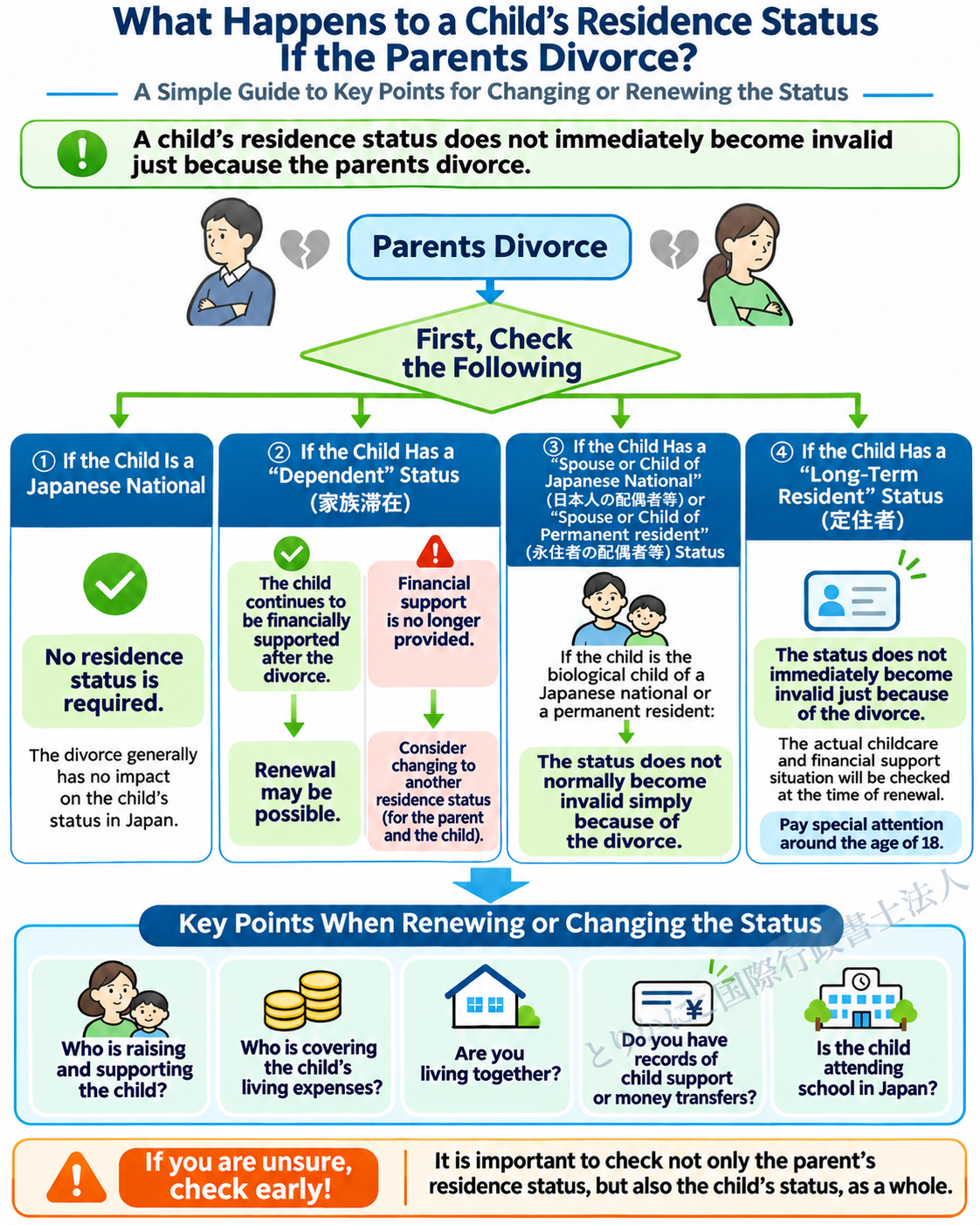
A child’s residence status does not automatically become invalid simply because their parents divorce.
However, changes in the child’s living arrangements and financial support may affect future applications for a change or extension of residence status.
The following three points are particularly important.
1. What Status of Residence Does the Child Currently Hold?
The impact of divorce differs depending on whether the child holds “Dependent,” “Long-Term Resident,” “Spouse or Child of Japanese National,” or another residence status.
2. Who Will Raise and Financially Support the Child After the Divorce?
In addition to legal custody, factors such as actual living arrangements, child support payments, and the child’s living environment are important.
3. Review the Parent’s and Child’s Residence Status Together
If a parent’s residence status changes, the child’s residence status should also be reviewed.
Even after a major change in family circumstances, such as divorce, it may still be possible for a child to continue living and receiving an education in Japan.
However, delaying the necessary procedures could make it more difficult to change or extend a residence status.
If you are considering divorce or are concerned about your child’s residence status after divorce, we recommend consulting an immigration specialist as early as possible.
Our office provides consultations regarding changes and extensions of residence status for foreign children.
We review the child’s current residence status and family circumstances to assess how the parents’ divorce may affect their immigration situation and explain the appropriate application procedures.
References
- Immigration Services Agency of Japan: “Dependent” Status of Residence
- Immigration Services Agency of Japan: “Spouse or Child of Japanese National” Status of Residence
- Immigration Services Agency of Japan: “Long-Term Resident” Status of Residence
- Immigration Services Agency of Japan: Examples of Approved and Denied Applications for Changes to “Long-Term Resident”
- Immigration Services Agency of Japan: Notification Concerning a Spouse
- Ministry of Justice: Amendments to the Civil Code Concerning Childcare Arrangements Following Parental Divorce

If you have any questions or concerns about your child’s residence status or visa application, please feel free to contact us. We are here to help!
Contact Us
You can contact us via LINE, WeChat, WhatsApp, telephone, or our online inquiry form.
Please choose whichever method is most convenient for you. We look forward to hearing from you!