


“I want to bring my child from my home country to Japan!”
“I work in Japan, but how much income do I need to bring my child here?”
“My child has already turned 18. Can I still apply for a Dependent visa?”
These are some of the questions we receive from foreign nationals living in Japan.
If you are a foreign national working in Japan and want to bring your child from overseas to live with you, one of the most common options is the “Dependent” (家族滞在) status of residence.
In this article, an administrative scrivener specializing in immigration procedures explains the requirements, necessary documents, application procedures, and important points to consider when bringing a foreign child to Japan.
- What Is a Dependent Visa in Japan?
- Which Residence Statuses Allow Parents to Bring Their Children to Japan?
- Three Important Requirements for Bringing Your Child to Japan
- How Much Annual Income Do You Need to Bring Your Child to Japan?
- Is There an Age Limit? Can Children Aged 18 or Older Apply?
- Can You Bring a Child Who Has Been Living with Their Grandparents Overseas?
- Required Documents for Bringing a Foreign Child to Japan
- Step-by-Step Process for Bringing Your Child to Japan
- Important Points to Consider When Applying for a Dependent Visa
- Frequently Asked Questions
- Q1. How Many Children Can I Bring to Japan?
- Q2. Can I Bring My Child to Japan Even If I Have Just Arrived Here?
- Q3. Can I Apply for a Dependent Visa If My Child Is Already 18 or Older?
- Q4. Can a Student Attending a Japanese Language School Bring Their Child to Japan?
- Q5. If I Am a Permanent Resident, Can I Bring My Child Under the Dependent Status?
- Q6. How Much Does It Cost to Apply for a Certificate of Eligibility for My Child?
- Q7. If My Child Is Born in Japan, Do I Need to Follow the Same Procedure?
- Conclusion: Early Preparation Is Important When Bringing Your Child to Japan
- Contact Us
- 044-379-8319
What Is a Dependent Visa in Japan?
The “Dependent” status of residence allows eligible spouses and children of foreign nationals who work or study in Japan to live together with them while receiving financial support.
For example, the following situations may qualify:
- A father working as an IT engineer in Japan wants to bring his child from China.
- A mother operating a restaurant business in Japan wants to bring her child from overseas.
- An international student conducting research at a Japanese graduate school wants to bring a child from their home country, provided the relevant requirements are met.
The Dependent status is intended for financially supported spouses and children.
Parents, siblings, grandparents, and other relatives are generally not eligible for this status.
Which Residence Statuses Allow Parents to Bring Their Children to Japan?
Not every foreign national living in Japan can sponsor a child under the Dependent status.
The first step is to check the status of residence held by the father or mother living in Japan.
| Parent’s Status of Residence | Eligibility for Child’s Dependent Visa |
|---|---|
| Engineer/Specialist in Humanities/International Services | Eligible |
| Business Manager | Eligible |
| Highly Skilled Professional | Eligible |
| Intra-company Transferee | Eligible |
| Skilled Labor | Eligible |
| Nursing Care | Eligible |
| Professor, Researcher, or Instructor | Eligible |
| Specified Skilled Worker (ii) | Eligible |
| Specified Skilled Worker (i) | Not eligible |
| Technical Intern Training | Not eligible |
| Student | Eligible in certain cases |
| Permanent Resident | Consider another status, such as Long-Term Resident |
| Long-Term Resident | Consider another status instead of Dependent |
What If the Parent Holds a Specified Skilled Worker (i) Status?
Foreign nationals holding the “Specified Skilled Worker (i)” status cannot generally bring their children to Japan from overseas under the Dependent status.
On the other hand, those holding the “Specified Skilled Worker (ii)” status are permitted to bring eligible spouses and children who depend on them financially.
However, even for Specified Skilled Worker (i) holders, there may be exceptional situations in which family members already living together in Japan can obtain a “Designated Activities” status.
These exceptional cases are different from ordinary applications to bring family members to Japan from overseas.
What If the Parent Is a Permanent Resident or Long-Term Resident?
If the parent holds “Permanent Resident” (永住者) or “Long-Term Resident” (定住者) status, the child cannot be brought to Japan under the Dependent status.
Instead, it is necessary to consider another appropriate status, such as Long-Term Resident, depending on factors including:
- The child’s place of birth
- The child’s age
- The legal parent-child relationship
- The child’s financial dependence on the parent
Please note that a child does not automatically become a Permanent Resident simply because their parent has Permanent Resident status.
Three Important Requirements for Bringing Your Child to Japan
When applying for a Dependent visa for your child, the following three requirements are particularly important.
Requirement 1: You Must Be Able to Prove the Parent-Child Relationship
First, there must be a legally recognized parent-child relationship between the child you wish to bring to Japan and the parent who will financially support the child.
In general, this relationship is proven through official documents such as a birth certificate.
For Chinese nationals, a notarized certificate confirming the parent-child relationship may also be required in certain circumstances.
Special attention is necessary when the parent has remarried.
For example, suppose a mother remarries a foreign man working in Japan and wishes to bring her child from a previous marriage to Japan.
In this case, it is necessary to confirm whether a legally recognized parent-child relationship exists between the mother’s new husband and the child.
Requirement 2: The Child Must Be Financially Dependent on the Parent
The Dependent status is intended for children who receive financial support from their parents.
Therefore, immigration authorities will consider whether the parent actually pays the child’s living and educational expenses and whether the parent intends to continue providing support after the child arrives in Japan.
For example, if a parent regularly sends money to a child living overseas, records of those transfers may help demonstrate the existing financial support relationship.
On the other hand, if the child is already employed and financially independent, it is necessary to carefully consider whether the child meets the requirements for Dependent status.
If the child is financially independent, other statuses of residence, such as “Student” or an employment-related status, should be considered.
Requirement 3: The Parent Must Have Sufficient Financial Resources to Support the Child in Japan
When examining a Dependent visa application, immigration authorities assess whether the parent living in Japan has sufficient financial resources to support the child.
For example, if the father works as a company employee in Japan and receives a regular monthly salary, the authorities will consider whether that income is sufficient to support the entire family.
The cost of bringing one child to Japan is naturally different from the cost of bringing a spouse and three children at the same time.
Therefore, the examination takes into account not only the parent’s income but also the number of dependents and the family’s expected living expenses in Japan.
After all, obtaining a residence status would not be very helpful if the family could not afford to live in Japan.
This is why financial stability is an important part of the examination.
How Much Annual Income Do You Need to Bring Your Child to Japan?
“Is an annual income of 3 million yen enough?”
“Can I bring my child to Japan if my monthly salary is 200,000 yen?”
Questions about income are among the most common inquiries we receive regarding Dependent visa applications.
The important point is that the Japanese government has not published a single nationwide minimum annual income requirement for the Dependent status.
Therefore, earning more than 3 million yen per year does not guarantee approval, and earning less than 2.5 million yen per year does not automatically mean that an application will be rejected.
Instead, the following factors need to be considered together:
- The parent’s annual income and monthly salary
- The number of family members who need financial support
- Monthly living expenses, including housing costs
- The amount of savings available
- Employment stability and continuity
- The child’s educational expenses and future living arrangements
For example, if the family owns its home, monthly housing expenses may be lower than those of a family paying rent.
This can be relevant when assessing the family’s financial situation.
In some cases, a parent may have only recently started working in Japan and may not yet be able to obtain a municipal taxation certificate.
In such circumstances, documents such as employment contracts, salary statements, and bank balance certificates may be used to explain the parent’s current income and ability to support the child.
Even if the parent’s income is relatively low, it may still be possible to demonstrate financial stability by considering savings and other available resources.
However, having savings does not automatically guarantee approval.
This is because bank balances can be temporarily increased, and immigration authorities may consider whether the funds genuinely demonstrate the ability to maintain a stable livelihood.
Is There an Age Limit? Can Children Aged 18 or Older Apply?
One of the most common misunderstandings about Dependent visas for children concerns age restrictions.
Some people believe that children can no longer apply for a Dependent visa once they turn 18.
However, this is not necessarily true.
According to the Immigration Services Agency of Japan’s official Q&A, there is no specific age limit for children applying under the Dependent status, provided that they are financially dependent on the sponsoring parent.
In other words, even children aged 18 or older may be eligible for the Dependent status of residence.
However, as a child gets older, immigration authorities may examine more carefully whether the child genuinely needs financial support from their parents.
Let’s Look at Three Examples
Case A: Bringing a 15-Year-Old Child to Japan
Suppose you want to bring your 15-year-old child, who is currently attending junior high school overseas, to Japan.
The child plans to live with both parents in Japan and eventually enter a Japanese high school.
In this situation, it is generally easier to explain that the child intends to live in Japan while receiving financial support from their parents.
Case B: Bringing a 19-Year-Old University Student to Japan
Suppose your 19-year-old child is currently attending university overseas and plans to move to Japan while receiving financial support from you.
The child is not automatically disqualified simply because they are over 18.
However, it is important to explain the child’s educational plans, living arrangements after arriving in Japan, and the reasons why financial support is necessary.
In practice, when the primary purpose is to study in Japan, applying for a “Student” status of residence is generally the more appropriate approach.
Case C: Bringing a 25-Year-Old Child Who Is Already Working
Suppose your 25-year-old child is already employed overseas and financially independent.
In this situation, it would be difficult to establish the financial dependence required for the Dependent status.
It may therefore be necessary to consider other options, such as a Student visa or an employment-related status of residence that the child qualifies for independently.
Can You Bring a Child Who Has Been Living with Their Grandparents Overseas?
Consider the following example.
Both parents are working in Japan, but their child has been living with the grandparents in China.
Although the parents and child have lived apart for several years, the parents now want to bring the child to Japan so that the family can live together.
An application for the Dependent status is possible even in this situation.
However, if the parents and child have lived separately for a long period, it may be helpful to explain the previous childcare arrangements and why the parents now wish to bring the child to Japan.
For example, the following questions may need to be addressed:
- Why have the parents and child been living separately until now?
- Who has been raising the child?
- Who has been paying the child’s living and educational expenses?
- Why have the parents decided to bring the child to Japan at this time?
- Who will the child live with after arriving in Japan?
- Which school does the child plan to attend in Japan?
Living separately for an extended period does not automatically make a child ineligible for a Dependent visa.
However, depending on the circumstances, it may be advisable to prepare a written explanation and evidence of financial support, such as remittance records.
Required Documents for Bringing a Foreign Child to Japan
When bringing a child from overseas under the Dependent status, the usual procedure is to apply for a Certificate of Eligibility (COE).
The Immigration Services Agency of Japan lists the following main documents for this type of application.
1. Basic Application Documents
| Document | Description |
|---|---|
| Application for Certificate of Eligibility | The application form designated by the Immigration Services Agency |
| Identification photograph | Generally 4 cm high × 3 cm wide, taken within six months before the application |
| Return envelope | Required depending on the application and issuance method, such as certain paper applications submitted at an immigration office |
| Documents proving the parent-child relationship | Birth certificate, family register, or equivalent official documents |
| Copy of the sponsor’s residence card or passport | Documents confirming the identity and residence status of the parent living in Japan |
Please check the latest application guidelines for exceptions, including situations in which an identification photograph is not required because of the child’s age.
2. If the Parent Works as a Company Employee in Japan
If the parent works in Japan under a status such as “Engineer/Specialist in Humanities/International Services,” the following documents are generally prepared:
- Certificate of Employment
- Municipal Resident Taxation Certificate
- Municipal Resident Tax Payment Certificate
If one certificate confirms both the total annual income and the tax payment status, it may be sufficient to submit only that certificate.
Depending on the circumstances, it may also be helpful to prepare additional documents, such as:
- Employment contract
- Recent salary statements
- Bank balance certificate
- Documents explaining the family’s living expenses in Japan
Municipal taxation and tax payment certificates are generally obtained from the municipality where the person was registered as a resident on January 1 of the relevant year.
3. If the Parent Is an International Student in Japan
If the parent is enrolled at a university or graduate school in Japan, their ability to support the child may be demonstrated through savings, scholarships, or other financial resources rather than employment income.
The following documents may be necessary:
- Certificate of Enrollment
- Bank balance certificate
- Scholarship certificate showing the amount and duration of financial support
- Other documents proving that the parent can cover the family’s living expenses
For international students, it may be difficult to support an entire family solely through part-time employment income.
Therefore, it may be necessary to explain continued financial support from family members or how savings were accumulated.
4. Additional Documents Depending on the Circumstances
The following documents may also be useful depending on the details of the application:
- Records of money transfers to the child
- Documents confirming the family’s housing arrangements in Japan
- A written statement explaining the reasons for bringing the child to Japan
These documents are not uniformly required in every application.
However, they may help explain the family circumstances and financial support arrangements.
Please also note that documents written in a foreign language must be accompanied by a Japanese translation.
As a general rule, certificates issued in Japan should have been issued within the previous three months.
Step-by-Step Process for Bringing Your Child to Japan
When bringing a child from overseas under the Dependent status, the process generally follows these five steps.
STEP 1: Prepare the Required Documents
The parent living in Japan prepares documents such as employment certificates and municipal taxation certificates.
For the child living overseas, documents such as a birth certificate must be obtained.
Japanese translations should also be prepared when necessary.
STEP 2: Apply for a Certificate of Eligibility at the Immigration Office
A parent or another eligible representative in Japan submits an Application for Certificate of Eligibility to the regional immigration office with jurisdiction over the application.
You can also request assistance from an administrative scrivener who is authorized to handle immigration applications on behalf of clients, such as our office.
STEP 3: Receive the Certificate of Eligibility
After the application has been examined, a Certificate of Eligibility (COE) will be issued if the applicant meets the relevant requirements.
We recommend receiving the COE electronically by email when this option is available.
Please note that a COE is generally valid for three months from its date of issuance.
In principle, the child should enter Japan within this validity period.
STEP 4: Apply for a Visa at a Japanese Embassy or Consulate Overseas
After obtaining the COE, the child applies for a visa at the Japanese embassy, consulate, or other designated visa application office responsible for their country or region of residence.
Visa application procedures and required documents vary depending on the country or region.
In many cases, a visa may be issued in approximately one to two weeks, although actual processing times vary.
STEP 5: The Child Enters Japan
Once the visa has been issued, the child can travel to Japan.
Depending on the airport of arrival, the child’s residence card may be issued upon entry or at a later date.
After establishing a residential address in Japan, the child must generally complete the required address registration procedure at the local municipal office within 14 days.
Important Points to Consider When Applying for a Dependent Visa
1. Changing from a Temporary Visitor Status Is Generally Difficult
Sometimes we receive questions such as:
“Can I bring my child to Japan on a tourist visa and then change it to a Dependent visa?”
However, changing from “Temporary Visitor” (短期滞在) status to a medium- or long-term residence status is generally not permitted unless there are unavoidable and exceptional circumstances.
2. Bringing an Older Child to Japan
If the child is already 18 or older or has reached working age, it is important to carefully consider the reasons why the child needs financial support and the purpose of their stay in Japan.
In particular, if the child intends to begin working immediately after arriving in Japan, another status of residence may be more appropriate than Dependent.
3. If the Parents Are Divorced
Even if the parents are divorced, a Dependent visa application may still be possible if the child is legally recognized as the child of the parent living in Japan and the other requirements, including financial dependence, are satisfied.
However, additional documents may be required depending on the child’s custody and care arrangements and the relationship with the other parent living overseas.
In particular, it is important to check the laws and procedures of the child’s home country concerning parental authority and consent for the child’s departure from that country.
4. If the Child Wants to Work in Japan
As a general rule, employment is not permitted under the Dependent status of residence.
However, if the child obtains permission to engage in activities outside their status of residence, they may work part-time within the scope of that permission.
The permitted working hours are generally limited to 28 hours per week.
If the child later graduates from high school or university and wishes to work full-time as a regular employee, they will need to consider changing to an appropriate residence status, such as:
- Engineer/Specialist in Humanities/International Services
- Long-Term Resident
- Designated Activities
The appropriate status will depend on the child’s individual circumstances.
Frequently Asked Questions
Q1. How Many Children Can I Bring to Japan?
There is no uniform numerical limit on the number of children who may apply under the Dependent status.
However, as the number of children increases, the family’s living expenses will also increase.
Therefore, the parent’s ability to financially support all dependent family members becomes particularly important.
Q2. Can I Bring My Child to Japan Even If I Have Just Arrived Here?
Yes, it is possible to apply even if you have only recently arrived in Japan.
However, if you cannot yet obtain municipal taxation certificates or other income-related documents, you may need to provide alternative evidence of your current financial situation.
Such documents may include employment contracts and salary statements.
Q3. Can I Apply for a Dependent Visa If My Child Is Already 18 or Older?
Yes. There is no automatic disqualification based solely on the child’s age.
However, the authorities will consider whether the child genuinely needs financial support from the parent and whether the other requirements are satisfied.
Q4. Can a Student Attending a Japanese Language School Bring Their Child to Japan?
International students enrolled at universities or graduate schools may be able to bring their children to Japan under the Dependent status.
On the other hand, bringing a child under the Dependent status while attending a Japanese language school is generally very difficult.
Q5. If I Am a Permanent Resident, Can I Bring My Child Under the Dependent Status?
No.
If the parent holds Permanent Resident status, the child must generally be considered for another appropriate residence status, such as Long-Term Resident.
The appropriate status depends on factors such as the child’s age, place of birth, and financial dependence on the parent.
Q6. How Much Does It Cost to Apply for a Certificate of Eligibility for My Child?
There is no application fee payable to the Immigration Services Agency for an Application for Certificate of Eligibility.
However, additional expenses may apply, including:
- Visa application fees overseas
- Document translation fees
- Professional fees if you hire an administrative scrivener
Q7. If My Child Is Born in Japan, Do I Need to Follow the Same Procedure?
No.
If a foreign child is born in Japan, the procedure is different from bringing a child to Japan from overseas.
If the child is born in Japan and intends to remain in Japan for more than 60 days after birth, an Application for Permission to Acquire Status of Residence must generally be submitted within 30 days of the child’s birth.
The appropriate status of residence depends on the child’s nationality and the parents’ residence statuses.
Conclusion: Early Preparation Is Important When Bringing Your Child to Japan
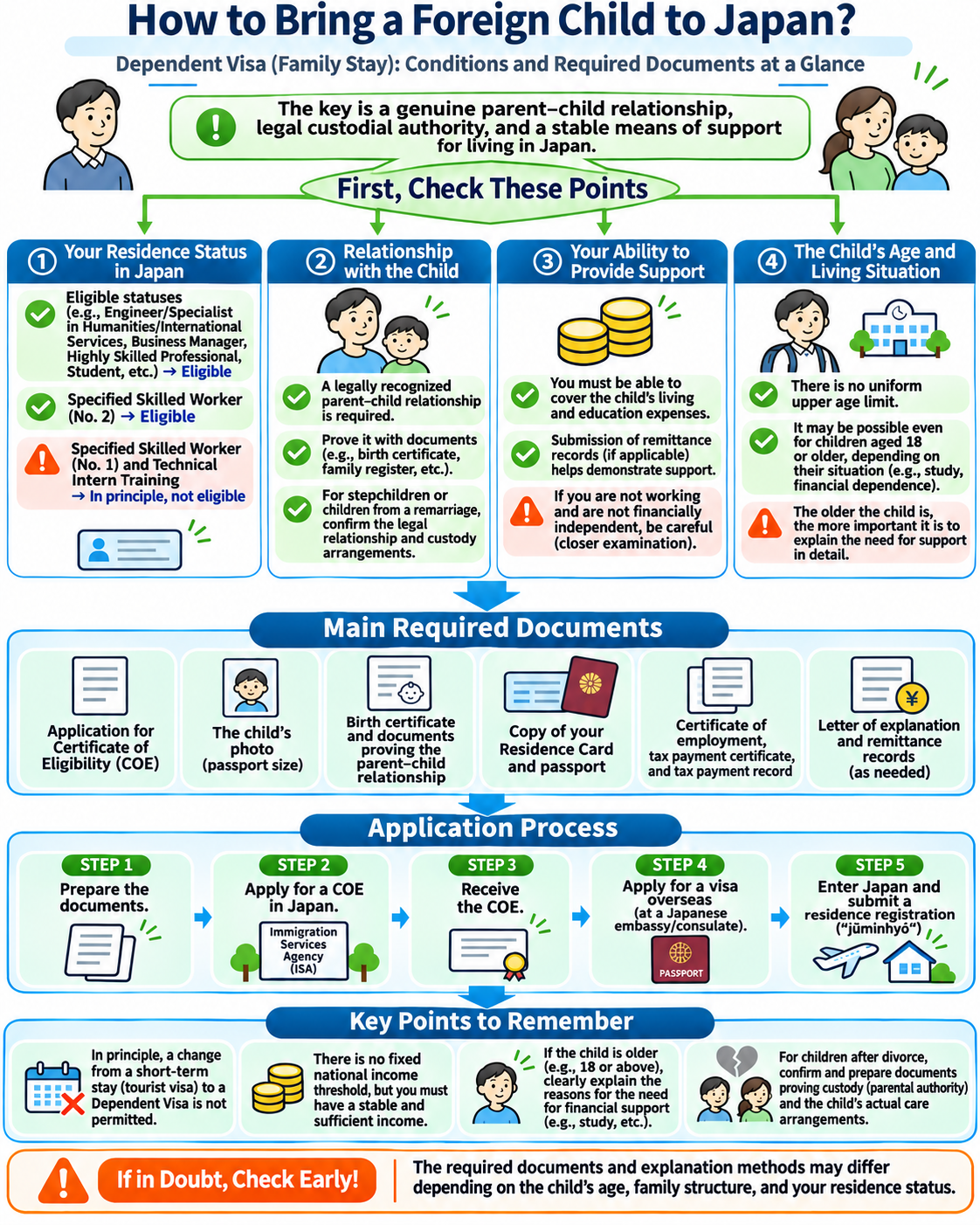
If you are a foreign national living in Japan and wish to bring your child from overseas, the Dependent status may be an available option, depending on your own status of residence.
However, simply proving that you are the child’s parent does not guarantee approval.
The following three points are especially important:
1. The parent must hold a status of residence that allows them to sponsor a child under the Dependent category.
2. The child must genuinely receive financial support from the parent.
3. The parent must have sufficient financial resources to raise and support the child in Japan.
When applying for a Dependent visa, it is important not only to collect the required documents but also to clearly explain the parent-child relationship and the actual financial support arrangements.
Consult an Immigration Specialist About Bringing Your Child to Japan
At TORIKANI International Administrative Scrivener Corporation, we provide consultations and assistance with residence status applications for foreign children.
In addition to Dependent visa applications, we can also advise on other residence statuses, such as Long-Term Resident, depending on your child’s circumstances.
“I want to bring my child to Japan, but I am not sure whether my income is sufficient.”
“I want to bring my child from a previous marriage to Japan.”
If you have any of these concerns, please feel free to contact us.
We can review your family circumstances and explain the available application options and necessary procedures.
References
- Immigration Services Agency of Japan: “Dependent” Status of Residence
- Immigration Services Agency of Japan: Application for Certificate of Eligibility
- Immigration Services Agency of Japan: Immigration and Residence Examination FAQ

If you have any questions or concerns, please feel free to contact us. We are here to help!
Contact Us
You can contact us through LINE, WeChat, WhatsApp, by telephone, or through our online inquiry form.
Please choose whichever method is most convenient for you. We look forward to hearing from you!