

“My baby was born in Japan. Do I need to apply for a visa or residence status?”
“I already submitted the birth notification. Does that mean all the procedures are complete?”
“More than 30 days have passed since my baby was born! What should I do?”
If you are a foreign couple living in Japan and have recently welcomed a baby, you may have questions like these.
In fact, even if a baby is born in Japan, the baby generally needs to obtain a status of residence to continue living in Japan if they do not have Japanese nationality.
One particularly important rule is that an application to acquire a status of residence must be submitted within 30 days of the child’s birth if the child intends to remain in Japan for more than 60 days.
In addition, several procedures are required after childbirth, including submitting a birth notification to the local municipal office and completing the necessary procedures at the embassy or consulate of the child’s country of nationality.
In this article, an administrative scrivener specializing in immigration procedures explains the necessary steps when a foreign baby is born in Japan, the application deadlines, required documents, and what to do if more than 30 days have already passed.
- Does a Foreign Baby Born in Japan Need a Status of Residence?
- The Most Important Rules: 14 Days, 30 Days, and 60 Days
- Three Procedures to Complete After Your Baby Is Born
- Which Status of Residence Can a Newborn Baby Obtain?
- Required Documents for an Application to Acquire Status of Residence
- What Happens If You Miss the 30-Day Application Deadline?
- How Much Does an Application to Acquire Status of Residence Cost?
- Frequently Asked Questions
- Q1. If My Baby Is Born in Japan, Will They Automatically Receive a Dependent Visa?
- Q2. If I Submit a Birth Notification, Do I Still Need to Complete Immigration Procedures?
- Q3. My Baby Does Not Have a Passport Yet. Can I Still Apply?
- Q4. Does the Baby Have to Visit the Immigration Office in Person?
- Q5. What Happens If I Apply Within 30 Days but the Application Is Still Being Examined After 60 Days?
- Q6. Do I Also Need to Apply for Health Insurance and Child Allowances After My Baby Is Born?
- Conclusion: Apply for Your Foreign Baby’s Residence Status Within 30 Days of Birth
- Contact Us
- 044-379-8319
Does a Foreign Baby Born in Japan Need a Status of Residence?
The first important point to understand is that being born in Japan does not automatically mean that a child acquires Japanese nationality.
Japan generally follows the principle of jus sanguinis, or nationality by descent, under which a child’s nationality is determined primarily by the nationality of their parents rather than their place of birth.
For example, consider the following family:
- Father: Canadian national, holding an “Engineer/Specialist in Humanities/International Services” status of residence
- Mother: Chinese national, holding a “Dependent” status of residence
- Baby: Born at a hospital in Japan
In this situation, the baby generally does not acquire Japanese nationality simply by being born in Japan.
Therefore, the baby must obtain their own status of residence to continue living in Japan.
If the father works in Japan under the “Engineer/Specialist in Humanities/International Services” status, it is common to apply for the baby’s “Dependent” (家族滞在) status of residence.
However, if either parent is a Japanese national at the time of birth and the requirements under Japan’s Nationality Act are satisfied, the baby may acquire Japanese nationality.
In such cases, an application to acquire a status of residence as a foreign national is not necessary.
The Most Important Rules: 14 Days, 30 Days, and 60 Days
When a foreign baby is born in Japan, there are three important deadlines to remember.
| Deadline | Required Procedure or Meaning |
|---|---|
| Within 14 days of birth | Submit a birth notification to the municipal office |
| Within 30 days of birth | Apply for permission to acquire a status of residence at the Immigration Services Agency |
| Up to 60 days after birth | Period during which a foreign baby born in Japan may stay without obtaining a status of residence |
Within 14 Days: Submit a Birth Notification to the Municipal Office
When your baby is born, you must submit a birth notification (出生届, Shussei Todoke) to the local municipal office within 14 days of the birth.
This requirement applies to both Japanese and foreign families.
A birth notification is the official procedure for registering the fact that a baby was born in Japan.
Within 30 Days: Apply for Permission to Acquire a Status of Residence
If a baby who does not have Japanese nationality intends to remain in Japan for more than 60 days after birth, an Application for Permission to Acquire Status of Residence (在留資格取得許可申請) must be submitted within 30 days of the baby’s birth.
This procedure is different from an ordinary application to extend a period of stay.
It is the procedure through which a newborn baby obtains their first status of residence in Japan.
Up to 60 Days: Staying in Japan Without a Status of Residence
A foreign baby born in Japan may stay in the country without a status of residence for up to 60 days after birth.
However, if the baby intends to remain in Japan for more than 60 days, they must obtain an appropriate status of residence.
One important point to remember is that submitting an application within 30 days does not automatically guarantee that the baby can remain in Japan beyond the 60-day period.
According to the Immigration Services Agency’s guidance, if the result of an application to acquire a status of residence has not been received by the end of the 60-day period, the baby may no longer be permitted to remain in Japan.
Therefore, it is important to submit the application as early as possible.
If there is a risk that the examination will not be completed before the deadline, contact the immigration office promptly to confirm how to proceed.
Three Procedures to Complete After Your Baby Is Born
When a baby is born into a foreign family in Japan, there are generally three main procedures to complete.
STEP 1: Submit a Birth Notification to the Municipal Office
The first step is to submit the baby’s birth notification.
Usually, the hospital where the baby is born provides a birth notification form that includes a medical birth certificate.
Complete the necessary information and submit the form to the municipal office within 14 days of the baby’s birth.
The main documents you may need include:
- Birth notification form and medical birth certificate
- Maternal and Child Health Handbook (母子健康手帳)
- Parents’ passports
- Parents’ residence cards
The required documents may differ depending on the municipality.
After submitting the birth notification, we recommend obtaining a Certificate of Acceptance of Birth Notification (出生届受理証明書), which may be needed for the immigration application.
It is also helpful to obtain a Certificate of Residence (住民票) listing all household members, including the newborn baby, as this can make subsequent procedures easier.
STEP 2: Register the Birth and Apply for a Passport at Your Country’s Embassy or Consulate
The next step is to complete the necessary birth registration procedures with the authorities of the baby’s country of nationality.
For example, if both parents are Chinese nationals, they should confirm the required procedures with the Chinese embassy or consulate in Japan.
Depending on the country, the procedures may include:
- Birth registration
- Confirmation of nationality
- Passport application
The required documents and procedures vary by country.
In addition, obtaining a passport for a newborn baby may take some time.
Do not miss the 30-day immigration application deadline while waiting for the baby’s passport to be issued.
If the passport has not yet been issued, contact the immigration office and explain the situation.
You may need to prepare documents showing that the passport application is in progress or a written explanation of why the passport is not yet available.
STEP 3: Apply for Permission to Acquire a Status of Residence at the Immigration Office
If the baby is expected to remain in Japan for more than 60 days after birth, an application must be submitted to the regional immigration office responsible for your residential area within 30 days of the birth.
This procedure is called an Application for Permission to Acquire Status of Residence.
Because a newborn baby cannot complete the procedure independently, the application is normally submitted by the father or mother as the child’s legal representative.
You can also request assistance from an administrative scrivener authorized to handle immigration applications, such as our office.
If the application is approved and the baby becomes a mid- to long-term resident, a residence card will also be issued for the baby.
Which Status of Residence Can a Newborn Baby Obtain?
The status of residence a newborn baby can obtain generally depends on the parents’ residence statuses, nationality, legal parent-child relationship, and other relevant circumstances.
The following table summarizes common situations.
| Parent’s Nationality or Status of Residence | Possible Status of Residence for the Baby |
|---|---|
| Engineer/Specialist in Humanities/International Services | Dependent |
| Business Manager | Dependent |
| Highly Skilled Professional | Dependent |
| Specified Skilled Worker (ii) | Dependent |
| Student | Dependent, if the relevant requirements are satisfied |
| Permanent Resident | Permanent Resident or Spouse or Child of Permanent Resident, depending on the circumstances |
| Long-Term Resident | Long-Term Resident or another appropriate status |
| Specified Skilled Worker (i) | Not eligible for Dependent status |
| Special Permanent Resident | Consider applying for Special Permanent Resident status |
| Japanese national | No residence status is necessary if the baby acquires Japanese nationality |
These are general examples.
The appropriate residence status may differ depending on both parents’ circumstances and the situation at the time of birth.
If the Father Holds an “Engineer/Specialist in Humanities/International Services” Status
For example, if the father works as an engineer at a Japanese company and the mother lives in Japan under a Dependent status, the baby will commonly apply for a Dependent status as well.
In this case, the immigration authorities will examine factors such as the father’s residence status and ability to financially support the child.
If a Parent Is a Permanent Resident
If either the father or mother is a Permanent Resident and the baby is born in Japan, it may be possible for the baby to apply for Permanent Resident status based on the birth.
An application for permanent residence based on birth must also generally be submitted within 30 days of the baby’s birth.
If a Parent Is a Special Permanent Resident
If either parent holds Special Permanent Resident status, the baby may also be eligible to apply for Special Permanent Resident status.
However, the procedure differs from an ordinary application to acquire a status of residence.
In principle, the application for Special Permanent Resident permission must be submitted to the municipal office within 60 days of the baby’s birth.
Required Documents for an Application to Acquire Status of Residence
The documents required when applying for a newborn baby’s status of residence depend on the status being requested.
Here, we will use an application for the “Dependent” status as an example.
Main Required Documents
| Document | Where to Obtain It / Additional Information |
|---|---|
| Application for Permission to Acquire Status of Residence | Official form designated by the Immigration Services Agency |
| Certificate of Acceptance of Birth Notification or equivalent document | Municipal office |
| Certificate of Residence including the baby | Municipal office |
| Baby’s passport | Embassy or consulate of the baby’s country of nationality; consult immigration if not yet issued |
| Copy of the sponsor’s residence card and passport | Father or mother |
| Sponsor’s Certificate of Employment | Employer |
| Sponsor’s Municipal Taxation and Tax Payment Certificates | Municipal office |
| Additional supporting documents | Depending on the sponsor’s circumstances and the application |
Official documents proving the baby’s birth and documents showing that the baby will live under the financial support of a parent are particularly important.
For families in which the sponsoring parent is an international student, documents such as bank balance certificates or scholarship certificates may be required instead of an employment certificate.
Make sure to check the latest list of required documents for the particular status of residence being requested.
Does a Newborn Baby Need an Identification Photograph?
Under the current rules, a photograph is generally not required if the child will be under one year old on the date the residence card is issued.
What Happens If You Miss the 30-Day Application Deadline?
“I was so busy with childbirth and childcare that I didn’t realize more than 30 days had passed.”
“I couldn’t apply because my baby’s passport wasn’t ready.”
What should you do in these situations?
Don’t Give Up Immediately If More Than 30 Days Have Passed
If you have missed the 30-day deadline, contact the immigration office responsible for your area as soon as possible.
You may be asked to explain why the application was delayed and provide information about your current circumstances.
For example, if the mother or baby was hospitalized or it took longer than expected to obtain the necessary documents, you may be able to prepare evidence explaining these circumstances.
Be Especially Careful If More Than 60 Days Have Passed
An even more serious situation arises when a baby has not obtained a status of residence more than 60 days after birth.
If a foreign baby born in Japan continues to stay in the country beyond 60 days without obtaining the necessary status of residence, this may lead to immigration violations, including unlawful overstay.
In addition, the baby’s resident registration may be removed, which could affect access to administrative services such as National Health Insurance and child allowances.
If this situation occurs, it is extremely important to contact the immigration office immediately.
Do not assume that everything is fine simply because the child is still a baby or because the parents already have valid residence statuses.
A child’s residence status must be considered separately from that of the parents.
How Much Does an Application to Acquire Status of Residence Cost?
There is no immigration application fee for obtaining a status of residence based on birth in Japan.
However, other expenses may arise, including:
- Fees for issuing a Certificate of Acceptance of Birth Notification
- Fees for obtaining Certificates of Residence
- Passport issuance fees
- Translation costs for required documents
- Professional fees if you hire an administrative scrivener
Although the immigration application itself is free, the documents must be prepared within a relatively short period of 30 days after birth.
Therefore, early preparation is essential.
Frequently Asked Questions
Q1. If My Baby Is Born in Japan, Will They Automatically Receive a Dependent Visa?
No.
Simply being born in Japan does not automatically grant a baby a status of residence.
To obtain a status such as Dependent, the appropriate application must be submitted.
Q2. If I Submit a Birth Notification, Do I Still Need to Complete Immigration Procedures?
Yes.
Submitting a birth notification to the municipal office and applying for permission to acquire a status of residence are two separate procedures.
If a foreign baby intends to remain in Japan for more than 60 days after birth, an application to acquire a status of residence must generally be submitted within 30 days of the birth.
Q3. My Baby Does Not Have a Passport Yet. Can I Still Apply?
If the baby’s passport has not yet been issued, it may be possible to discuss alternative arrangements with the immigration office.
For example, you may be asked to submit documents proving that the passport application is in progress or a written explanation of the situation.
Do not wait for the passport to be issued if doing so would cause you to miss the 30-day deadline.
Contact the immigration office as early as possible.
Q4. Does the Baby Have to Visit the Immigration Office in Person?
Normally, the baby does not need to appear at the immigration office in person.
The application is generally submitted by a legal representative, such as the father or mother.
You can also request assistance from an administrative scrivener authorized to handle immigration applications.
Q5. What Happens If I Apply Within 30 Days but the Application Is Still Being Examined After 60 Days?
For an Application for Permission to Acquire Status of Residence, submitting the application does not automatically guarantee permission to stay beyond 60 days after birth.
If the examination has not been completed, contact the immigration office promptly before the baby reaches 60 days of age to confirm how to proceed.
Q6. Do I Also Need to Apply for Health Insurance and Child Allowances After My Baby Is Born?
Yes.
After your baby is born, you may also need to complete procedures related to:
- Health insurance
- Child allowances
- Medical expense subsidies for children
- Other municipal childcare and welfare services
These procedures are separate from the immigration application.
When submitting the birth notification, we recommend asking your municipal office about the additional procedures you need to complete.
Conclusion: Apply for Your Foreign Baby’s Residence Status Within 30 Days of Birth
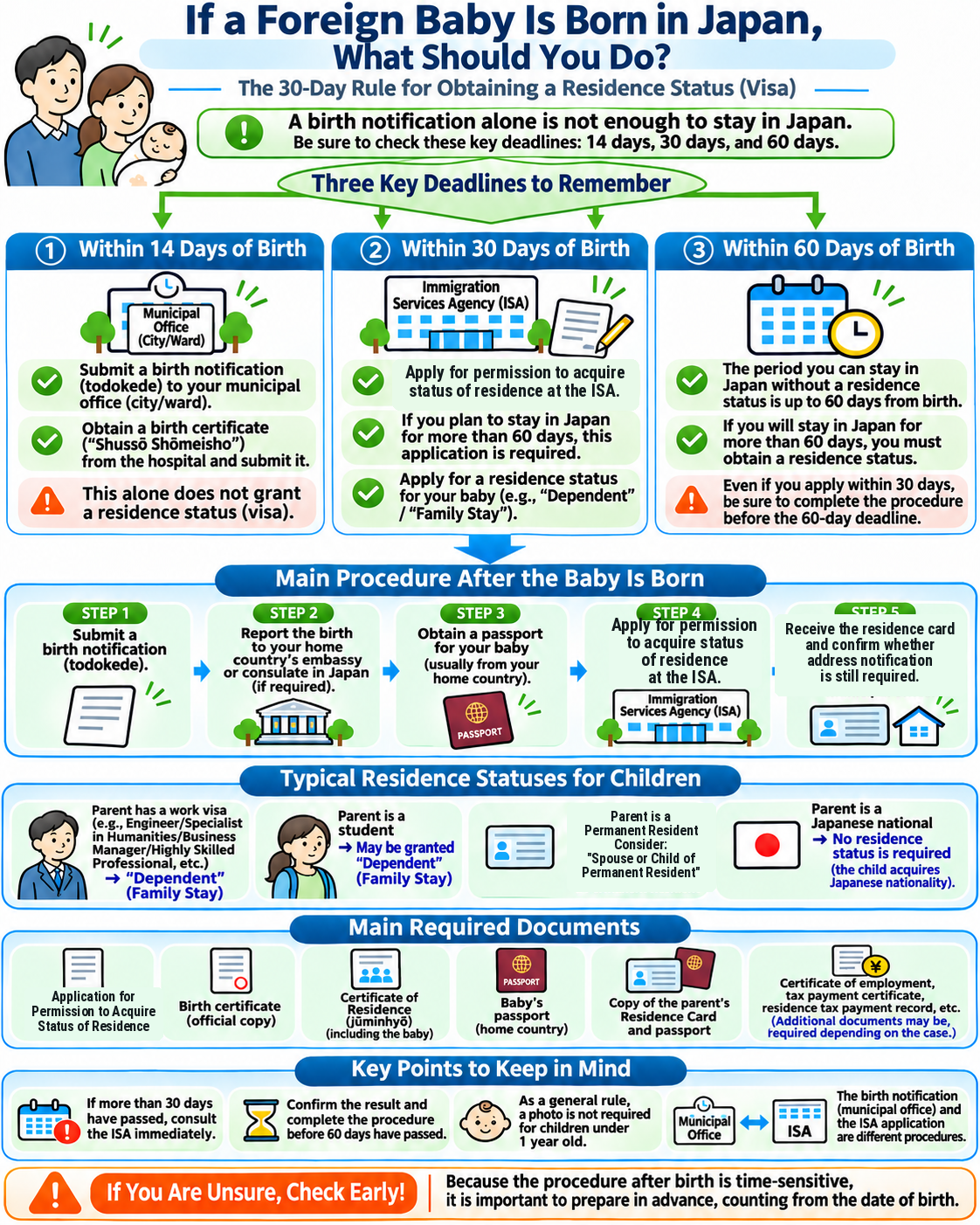
When a foreign baby is born in Japan, several procedures may be required, including submitting a birth notification, applying for a status of residence, and registering the birth with the authorities of the baby’s country of nationality.
The three most important deadlines to remember are:
1. Within 14 days of birth: Submit a birth notification to the municipal office.
2. Within 30 days of birth: Apply for permission to acquire a status of residence if the baby intends to stay in Japan for more than 60 days.
3. Before 60 days have passed: Take the necessary steps early so that the baby can obtain the appropriate status of residence.
The status of residence the baby can obtain also depends on the parents’ residence statuses.
In some cases, the baby may qualify for “Dependent,” while in other cases, it may be necessary to consider “Permanent Resident,” “Spouse or Child of Permanent Resident,” or “Long-Term Resident.”
The period immediately after childbirth is naturally a very busy time for families.
However, immigration procedures have strict deadlines.
We recommend checking the necessary documents before your baby is born and preparing to complete the required procedures as soon as possible after the birth.
Need Help Applying for Your Newborn Baby’s Residence Status?
At TORIKANI International Administrative Scrivener Corporation, we provide consultations and application assistance for foreign babies born in Japan who need to acquire a status of residence.
“My baby was born in Japan, but I don’t know which status of residence to apply for.”
“I’m worried that I won’t be able to submit the application within 30 days.”
“More than 30 days have already passed since my baby was born.”
If you have any of these concerns, please feel free to contact us.
We will review your current circumstances and explain the necessary procedures and available options.
We are here to help.
References
- Immigration Services Agency of Japan: Application for Permission to Acquire Status of Residence
- Immigration Services Agency of Japan: Acquisition of Status of Residence (Article 22-2 of the Immigration Control Act)
- Immigration Services Agency of Japan: Important Information and Precautions When Applying for Residence Status
- Immigration Services Agency of Japan: “Dependent” Status of Residence
- Immigration Services Agency of Japan: Guidebook on Living and Working in Japan
- Childcare Support Website for Foreign Residents: Three Important Procedures When a Baby Is Born
Contact Us
You can contact us through LINE, WeChat, WhatsApp, by phone, or through our online inquiry form.
Please choose whichever method is most convenient for you. We look forward to hearing from you!