

“Will my child be unable to renew their Dependent visa once they turn 18?”
“Can my child continue living in Japan after turning 20 if they are still financially supported by their parents?”
“Does my child need to change from a Dependent visa to a Student visa when entering university?”
We often receive questions like these from foreign families living in Japan.
For families with children approaching high school graduation or university enrollment, deciding when to change their children’s status of residence can be a major concern.
The important point is that Japan’s “Dependent” (家族滞在) status of residence does not have a uniform age limit of 18 or 20.
Therefore, even children who are over 18 or 20 may be able to extend their period of stay under the Dependent status if they continue living with financial support from their parents.
However, because adult children may be able to work and become financially independent, the immigration authorities will pay particular attention to whether the child is genuinely dependent on their parents.
- Is There an Age Limit of 18 or 20 for a Dependent Visa?
- Can You Renew a Dependent Visa at Ages 18, 20, or 22?
- What Does “Financial Dependence” Mean When Renewing an Adult Child’s Dependent Visa?
- Do You Need to Change to a Student Visa When Entering University or Vocational School?
- Can You Renew a Dependent Visa If You Neither Study Nor Work After High School Graduation?
- What Happens to Dependent Status If the Child Starts Working?
- Situations Where Extending Dependent Status May Become Difficult
- Required Documents for Extending Dependent Status for a Child Aged 18 or Older
- Frequently Asked Questions
- Q1. Does My Dependent Visa Automatically Expire When I Turn 18?
- Q2. Can a University Student Over 20 Renew Their Dependent Visa?
- Q3. Do I Have to Change to a Student Visa When I Enter University?
- Q4. Can I Renew My Dependent Visa If I Live Separately from My Parents?
- Q5. Can Parents Bring a Child Aged 18 or Older to Japan Under the Dependent Status?
- Q6. What Happens If I Graduate from University but Have Not Found a Job?
- Q7. Can I Renew My Dependent Visa If I Earn Money from a Part-Time Job?
- Conclusion: You May Be Able to Renew Your Dependent Visa Even After Turning 18 or 20
- Contact Us
- 044-379-8319
Is There an Age Limit of 18 or 20 for a Dependent Visa?
First, it is important to understand the basic purpose of the Dependent status of residence.
The Dependent status allows eligible spouses and children who receive financial support from foreign nationals holding certain residence statuses in Japan to live in the country with their families.
For example, if a father works for a Japanese company under the “Engineer/Specialist in Humanities/International Services” status of residence, his financially dependent child may be eligible to live in Japan under the Dependent status.
But does the child have to change their residence status when they turn 18?
The answer is no.
The official FAQ published by the Immigration Services Agency of Japan includes the following question and answer:
Q48: Is there an age limit for entering Japan under the Dependent status of residence?
A: There is no specific age limit, provided that the person is financially dependent on the sponsor.
In other words, there is no uniform legal requirement that a child applying for Dependent status must be under 18 or under 20.
However, the absence of an age limit does not mean that every application will be approved.
For adult children, it may be necessary to provide a more detailed explanation of their actual financial dependence and living circumstances.
Can You Renew a Dependent Visa at Ages 18, 20, or 22?
Let’s look at how applications for an extension of the Dependent status may be considered at different ages.
| Child’s Age and Circumstances | Possibility of Extending Dependent Status |
|---|---|
| 17 years old, high school student | Extension may be possible if financial dependence continues |
| 18 years old, high school student | Age alone is not a problem |
| 19 years old, university student | Extension may be possible if the child remains financially dependent on their parents |
| 20 years old, university student | Extension may be possible |
| 22 years old, graduate student | Extension may be possible if financial dependence continues |
| 23 years old, graduated from university and unemployed | Examined individually based on actual financial dependence and living circumstances |
| 25 years old, working full-time as a regular employee | Generally does not meet the underlying requirements for Dependent status |
The most important factor is not simply the child’s age.
What matters is whether the child continues to live as a financially dependent family member.
For example, a 20-year-old university student whose tuition fees and living expenses are paid by their father may still be eligible to extend their Dependent status if they are not financially independent.
On the other hand, if a 20-year-old is already working full-time and can support themselves entirely through their own income, maintaining Dependent status may become difficult.
What Does “Financial Dependence” Mean When Renewing an Adult Child’s Dependent Visa?
When a child aged 18 or older applies to extend their Dependent status, one of the most important factors is the financial support relationship with their parents.
Financial dependence means that the parent provides financial support for the child’s daily living expenses and other necessary costs.
For example:
- The father pays the child’s tuition fees.
- The mother pays for the child’s food and living expenses.
- The entire family lives primarily on the parents’ income.
- The child attends university and receives money from their parents to cover living expenses.
In these situations, it may be possible to demonstrate that the child remains financially dependent on their parents, even after reaching adulthood.
Does the Child Have to Live with Their Parents?
There is no uniform rule requiring a child holding Dependent status to live in the same household as their parents.
For example, a father may work in Tokyo while his child attends a university in another prefecture and lives alone.
If the father continues to provide financial support, the child may still be considered financially dependent.
However, if the parent and child live separately, it is advisable to prepare evidence of financial support, such as bank transfer records or documents showing payment of tuition fees.
What If the Child Has a Part-Time Job?
Having a part-time job does not automatically mean that a child is no longer financially dependent on their parents.
For example, a university student may have obtained permission to engage in activities outside their status of residence and work part-time several days a week.
Even if the student earns some income, maintaining Dependent status may still be possible if the parents continue to cover most of the child’s living expenses.
However, if the child earns enough to support themselves independently, it may be difficult to demonstrate that they genuinely remain financially dependent on their parents.
Please note: The definition of a dependent under Japan’s tax or health insurance systems is not necessarily the same as the definition of financial dependence under immigration law.
Being classified as a dependent family member for tax purposes does not automatically guarantee approval of an extension of Dependent status.
Do You Need to Change to a Student Visa When Entering University or Vocational School?
“My child is graduating from high school and entering university, so I thought we had to change their visa to Student.”
We sometimes receive questions like this.
However, entering a university or vocational school does not automatically mean that the child must change their status of residence to “Student” (留学).
The Dependent status allows eligible family members to live their daily lives in Japan while receiving financial support from their sponsor.
Attending school while remaining financially dependent on a parent is compatible with this status.
Therefore, in some cases, a child can continue studying at a Japanese university while maintaining their Dependent status.
What Are the Benefits of Changing to Student Status?
On the other hand, there are situations in which changing to Student status may be worth considering when entering university.
One example is applying for a scholarship.
Some scholarship programs have specific eligibility requirements concerning the applicant’s status of residence.
The Immigration Services Agency’s official FAQ explains that applications to change from Dependent to Student status for the purpose of qualifying for scholarships are examined with consideration of the relevant circumstances.
However, some scholarships and financial support programs are also available to students who remain under Dependent status.
Therefore, it is important to check the eligibility requirements of the particular scholarship or support program before deciding whether to change residence status.
Rather than automatically changing to Student status upon entering university, we recommend considering the child’s current financial dependence and the requirements of any programs they wish to use.
Can You Renew a Dependent Visa If You Neither Study Nor Work After High School Graduation?
Some children graduate from high school but do not enter university and have not yet found a job.
For example, consider the following situation.
The father works as a company employee in Japan.
His 18-year-old child has graduated from high school but is currently studying Japanese at home while considering future educational and career options.
The father pays all the child’s living expenses.
In this situation, an application for an extension of Dependent status is not automatically rejected simply because the child is neither studying at an educational institution nor working.
However, after the child reaches adulthood, the immigration authorities may consider factors such as:
- What the child has been doing since graduating from high school
- Whether the child intends to continue studying or find employment
- Who currently pays the child’s living expenses
- Whether the child lives with their parents
- What the child’s future plans are
For example, if the child continues studying Japanese and plans to enter an educational institution or obtain professional qualifications, it may be helpful to explain those circumstances in detail.
There may also be situations in which the child was unable to continue their education because of family circumstances.
In such cases, it may be advisable to prepare a written statement explaining both the existing financial support relationship and the child’s living circumstances after graduation.
However, submitting a written statement does not guarantee approval.
What matters is whether the child’s actual circumstances continue to satisfy the requirements for Dependent status.
What Happens to Dependent Status If the Child Starts Working?
If the child starts working in Japan, it may be necessary to change their status of residence.
A person holding Dependent status who has obtained permission to engage in activities outside their status of residence may generally work part-time for up to 28 hours per week.
However, if the child intends to work full-time as a regular employee, they must generally change to a status of residence appropriate for their employment.
For example, if the child graduates from university and obtains a job as an IT engineer, changing to “Engineer/Specialist in Humanities/International Services” may be an option.
Changing to “Long-Term Resident” After High School Graduation
The Immigration Services Agency has published special arrangements for foreign nationals who have been living in Japan under Dependent status and wish to work after graduating from high school.
Under these arrangements, eligible individuals may be able to change their status to “Long-Term Resident” (定住者) if they meet certain requirements.
The main requirements include:
- Having completed compulsory education, including elementary and junior high school, in Japan
- Having graduated or being expected to graduate from a Japanese high school
- Having continued residing in Japan under Dependent status or another eligible status since entering Japan
- Having entered Japan before turning 18
- Having secured employment in Japan
- Having properly fulfilled public obligations
Depending on how and when the child entered or transferred into a Japanese high school, it may also be possible to consider changing to “Designated Activities” (特定活動).
Please note that the requirement to have entered Japan before turning 18 applies to these special arrangements for changing residence status to work after high school graduation.
It is not an age limit for the Dependent status itself.
These two rules should not be confused.
Situations Where Extending Dependent Status May Become Difficult
For adult children holding Dependent status, the most important factors are their actual financial dependence and the activities they engage in, rather than age alone.
The following situations require particular attention.
1. The Child Has Become Financially Independent
This applies when the child earns enough income to cover their own living expenses without financial support from their parents.
In such circumstances, the child may no longer satisfy the underlying requirement of being financially dependent on their sponsor.
2. The Child Works Beyond the Scope of Their Work Permission
Even if a child holding Dependent status has obtained comprehensive permission to engage in activities outside their status of residence, working beyond the generally permitted limit of 28 hours per week may create immigration problems.
Depending on the circumstances, this may constitute unauthorized employment.
It is therefore essential to comply with the conditions of the work permission.
3. The Parent’s Financial Situation Has Changed Significantly
For example, the father who financially supports the family may lose his job and become unable to cover the entire family’s living expenses.
This does not automatically mean that an extension application will be rejected.
However, it may be necessary to explain the family’s financial circumstances, including available savings and expected future income.
4. The Parent’s Status of Residence Has Changed
For example, suppose the father changes his status from “Engineer/Specialist in Humanities/International Services” to “Permanent Resident.”
Permanent Resident is not one of the residence statuses that allows a person to act as a sponsor under the Dependent category.
Therefore, it may be necessary to consider changing the child’s status of residence to another appropriate category, such as Long-Term Resident.
Particular care is required if the child is already 18 or older because the eligibility requirements for certain Long-Term Resident categories include age restrictions.
Whenever a parent’s status of residence changes, it is important to review the child’s status of residence at the same time.
Required Documents for Extending Dependent Status for a Child Aged 18 or Older
When applying for an extension of the period of stay under Dependent status, the basic documents designated by the Immigration Services Agency generally apply regardless of the child’s age.
The main documents include:
| Document | Description |
|---|---|
| Application for Extension of Period of Stay | Official application form designated by the Immigration Services Agency |
| Identification photograph | Generally 4 cm high × 3 cm wide |
| Passport and residence card | To be presented when applying |
| Birth certificate or equivalent document | To prove the parent-child relationship |
| Copy of the sponsor’s residence card or passport | To confirm the parent’s residence status |
| Certificate of Employment or equivalent document | To confirm the sponsor’s occupation |
| Municipal Taxation and Tax Payment Certificates | To confirm the sponsor’s income and tax payment status |
If the sponsor is an international student or another person who does not engage in income-generating employment, documents such as bank balance certificates or scholarship certificates may be necessary to demonstrate the ability to cover living expenses.
Additional Documents That May Be Helpful for Adult Children
For applicants aged 18 or older, it may be useful to prepare additional documents depending on their circumstances.
These may include:
- Certificate of Enrollment
- Copy of student identification card
- Records of tuition payments
- Records of financial transfers from parents
- Documents confirming the child’s income from part-time work
- Certificate of Residence showing whether the parent and child live together
- Written statement explaining the child’s living circumstances after graduation
For example, a university student may submit a Certificate of Enrollment to demonstrate that they are continuing their education.
Similarly, if the child lives separately from their parents, bank transfer records or tuition payment documents may help show that they continue to receive financial support.
These additional documents are not necessarily required for every application.
Frequently Asked Questions
Q1. Does My Dependent Visa Automatically Expire When I Turn 18?
No.
A person’s Dependent status does not automatically become invalid simply because they turn 18.
If the child continues to receive financial support from their parents, an extension of the period of stay may still be possible.
Q2. Can a University Student Over 20 Renew Their Dependent Visa?
Yes, it may be possible.
For example, a 20-year-old university student whose parents pay their tuition fees and living expenses may continue to qualify for Dependent status.
However, applications are examined individually based on the actual financial support relationship and the child’s living circumstances.
Q3. Do I Have to Change to a Student Visa When I Enter University?
No.
Simply entering university does not automatically require a change to Student status.
If the child continues to satisfy the requirements for Dependent status, they may be able to attend university while maintaining that status.
However, changing to Student status may be worth considering in certain situations, such as when applying for a scholarship with specific residence status requirements.
Q4. Can I Renew My Dependent Visa If I Live Separately from My Parents?
Living separately from your parents does not automatically make you ineligible for an extension.
For example, a university student who lives away from home may still be eligible if their parents continue providing financial support.
It is advisable to prepare documents proving the financial support relationship, such as bank transfer records.
Q5. Can Parents Bring a Child Aged 18 or Older to Japan Under the Dependent Status?
Yes, an application may be possible.
Because the Dependent status has no uniform age limit, a child aged 18 or older may still be eligible for a new application.
However, the older the child is, the more important it becomes to clearly explain why they remain financially dependent on their parents and what they intend to do in Japan.
Q6. What Happens If I Graduate from University but Have Not Found a Job?
Graduating from university does not automatically result in the loss of Dependent status.
However, you may need to explain your current living arrangements, financial dependence, and future plans.
Whether you can continue under Dependent status or should change to another status must be considered individually.
Q7. Can I Renew My Dependent Visa If I Earn Money from a Part-Time Job?
Having income from part-time employment does not automatically mean that an extension application will be rejected.
If you comply with the conditions of your permission to work and continue living with financial support from your parents, an extension may still be possible.
However, if your income is sufficient to make you financially independent, special attention is required.
Conclusion: You May Be Able to Renew Your Dependent Visa Even After Turning 18 or 20
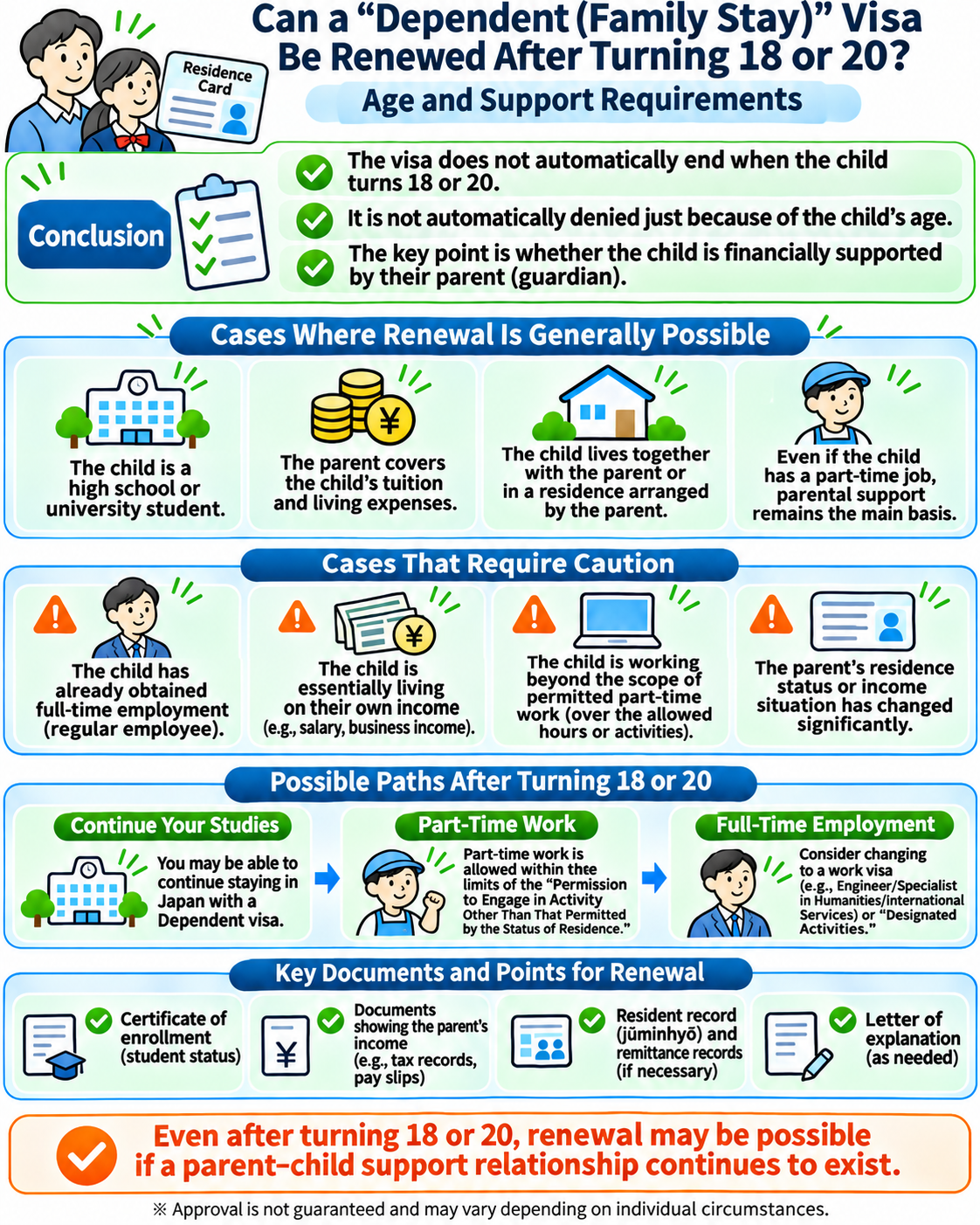
Japan’s Dependent status of residence does not have a uniform age limit of 18 or 20.
Therefore, even adult children may be eligible to extend their Dependent status if they continue living in Japan while receiving financial support from their parents.
It is important not to judge eligibility based solely on age.
Instead, the child’s current financial dependence, living arrangements, educational situation, and future plans should be considered when determining the most appropriate status of residence.
Consult an Immigration Specialist About Your Child’s Dependent Visa Extension or Change of Status
At TORIKANI International Administrative Scrivener Corporation, we provide consultations and application assistance regarding residence statuses for foreign children in Japan.
We can help with situations such as:
“I want to renew my child’s Dependent visa now that they have turned 18.”
“I want to know whether my child can continue living in Japan under Dependent status after turning 20.”
“My child is entering university, and I want to know whether they should change to Student status.”
“My child wants to work after graduating from high school, so we are considering changing to Long-Term Resident or Designated Activities.”
If you have any of these concerns, we can review your child’s current residence status and your family’s living circumstances to help identify the appropriate application procedures.
Please feel free to contact us.
References
- Immigration Services Agency of Japan: “Dependent” Status of Residence
- Immigration Services Agency of Japan: Immigration and Residence Examination FAQ (Q47 and Q48)
- Immigration Services Agency of Japan: Permission to Engage in Activities Outside the Scope of Dependent Status
- Immigration Services Agency of Japan: For Dependent Status Holders Who Wish to Work After Graduating from High School
- Immigration Services Agency of Japan: “Long-Term Resident” Status of Residence
Contact Us
You can contact us through LINE, WeChat, WhatsApp, by phone, or through our online inquiry form.
Please choose whichever method is most convenient for you. We look forward to hearing from you!