

“Will my child automatically acquire Japanese nationality if one parent is Japanese and the other is a foreign national?”
“Can my child have both Japanese nationality and another nationality?”
“What happens to my baby’s residence status if I am not married to the Japanese father?”
When a child is born to a Japanese national and a foreign national, many parents have questions about the child’s nationality and residence status.
The important point is that if either the father or mother is a Japanese national at the time of birth and a legally recognized parent-child relationship exists, the child generally acquires Japanese nationality at birth.
Therefore, the child does not need a status of residence or visa to live in Japan.
However, in certain situations, such as when the Japanese father and foreign mother are not legally married, the child may not acquire Japanese nationality at birth. This depends on the legal parent-child relationship and the timing of the father’s acknowledgment of paternity.
In addition, if the child is born outside Japan, it may be necessary to complete a procedure called “Reservation of Japanese Nationality” to prevent the child from losing Japanese nationality.
In this article, an administrative scrivener specializing in immigration procedures explains the nationality of children born to Japanese and foreign parents, focusing on the place of birth, parents’ marital status, acknowledgment of paternity, dual nationality, and residence status.
- Does a Child Born to a Japanese and a Foreign Parent Acquire Japanese Nationality?
- Differences Between Having a Japanese Father and a Japanese Mother
- What Happens If the Japanese Father and Foreign Mother Are Not Married?
- Can a Child Have Both Japanese Nationality and a Foreign Nationality?
- What Residence Status Can a Child Obtain If They Do Not Acquire Japanese Nationality?
- Procedures Required When a Child Is Born in Japan
- Can a Child Born Overseas Acquire Japanese Nationality?
- Quick Reference: Nationality and Residence Status of Children Born to Japanese and Foreign Parents
- Frequently Asked Questions
- Q1. Does a Child Born to a Japanese National and a Foreign National Always Acquire Japanese Nationality?
- Q2. If My Child Has Both Japanese and Foreign Nationalities, Do They Need a Japanese Visa?
- Q3. If the Japanese Father Acknowledges Paternity After Birth, Does the Child Automatically Become Japanese?
- Q4. Can a Child Born Overseas Acquire Japanese Nationality?
- Q5. Does a Child with Dual Nationality Automatically Lose Japanese Nationality When They Turn 20?
- Q6. If the Japanese Father and Foreign Mother Divorce, What Happens to the Child’s Japanese Nationality?
- Q7. What Happens to a Foreign Child’s Residence Card If They Acquire Japanese Nationality?
- Conclusion: It Is Important to Consider Nationality and Residence Status Separately
- Contact Us
- 044-379-8319
Does a Child Born to a Japanese and a Foreign Parent Acquire Japanese Nationality?
Article 2 of Japan’s Nationality Act sets out the conditions under which a child acquires Japanese nationality by birth.
The main conditions are as follows:
- The father or mother is a Japanese national at the time of the child’s birth.
- If the father died before the child’s birth, he was a Japanese national at the time of his death.
- The child is born in Japan, and both parents are unknown or have no nationality.
For children born to a Japanese national and a foreign national, the first condition is generally the most relevant.
For example:
- A child is born to a Japanese father and a Chinese mother.
- A child is born to a Russian father and a Japanese mother.
- A married Japanese and foreign couple has a baby overseas.
In these situations, the child generally acquires Japanese nationality if the relevant requirements, including the legally recognized parent-child relationship at birth, are satisfied.
In principle, whether the child is born in Japan or overseas is not the deciding factor in acquiring Japanese nationality.
However, special attention is required for children born overseas because of the nationality reservation procedure explained later in this article.
Differences Between Having a Japanese Father and a Japanese Mother
When determining a child’s nationality, it is important to consider which parent is Japanese and whether the parents are legally married.
If the Mother Is Japanese and the Father Is a Foreign National
Consider the following family:
- Mother: Japanese national
- Father: Korean national
- Child: Born in Japan
In this situation, the child generally acquires Japanese nationality at birth because the mother is Japanese.
Even if the parents are not legally married, a child born to a Japanese mother generally acquires Japanese nationality.
Therefore, the child does not need to apply for permission to acquire a status of residence to live in Japan.
However, procedures such as submitting a birth notification and registering the birth in the Japanese family register are still necessary.
If the Father Is Japanese and the Mother Is a Foreign National, and They Are Legally Married
Consider the following family:
- Father: Japanese national
- Mother: Chinese national
- Child: Born in Japan
If the parents are legally married and the child has a legally recognized parent-child relationship with the Japanese father, the child generally acquires Japanese nationality at birth.
In this case, the child does not need a status of residence to live in Japan.
Whether the child can also acquire the foreign mother’s nationality depends on the nationality laws of her country.
If the Father Is Japanese and the Mother Is a Foreign National, but They Are Not Married
This situation requires particular attention.
If a Japanese man and a foreign woman are not legally married, the child’s eligibility for Japanese nationality at birth may depend on whether the Japanese father acknowledged paternity before the child was born.
Let’s examine this in more detail.
What Happens If the Japanese Father and Foreign Mother Are Not Married?
Suppose a Japanese man and a Vietnamese woman are expecting a baby but are not legally married.
In this case, the timing of the Japanese father’s acknowledgment of paternity can make an important difference.
If the Father Acknowledges Paternity Before Birth
If the Japanese father completes a prenatal acknowledgment of paternity (胎児認知) before the child is born, a legally recognized father-child relationship is established at birth.
As a result, the child generally acquires Japanese nationality by birth.
If the baby is born in Japan, there is no need to apply for a status of residence as a foreign national.
However, prenatal acknowledgment of paternity differs from acknowledgment after birth in both its procedure and legal effects.
Therefore, it is important to confirm the necessary procedures before the child is born.
If the Father Acknowledges Paternity After Birth
What happens if the Japanese father does not acknowledge paternity before the child is born but does so after birth?
In this situation, the child generally does not acquire Japanese nationality at birth because the legally recognized father-child relationship was not established at that time.
However, if the Japanese father acknowledges paternity after the child is born, the child may be able to acquire Japanese nationality under Article 3 of the Nationality Act.
Reference: Ministry of Justice — Nationality Acquisition Procedures
The main requirements are as follows:
- The child must be under 18 years old.
- The child must have been legally acknowledged by the Japanese father.
- The father must have held Japanese nationality at the time of the child’s birth.
- The father must currently hold Japanese nationality, or must have held Japanese nationality at the time of his death if he is deceased.
- The child must never have previously held Japanese nationality.
If these requirements are satisfied, the child may acquire Japanese nationality by submitting a Notification of Acquisition of Japanese Nationality to the Minister of Justice.
However, acknowledgment of paternity after birth does not automatically make the child a Japanese national.
A separate nationality acquisition notification procedure is required.
If the child resides in Japan, the notification is submitted to the Legal Affairs Bureau or District Legal Affairs Bureau.
If the child resides overseas, it is generally submitted through a Japanese embassy or consulate.
Can a Child Have Both Japanese Nationality and a Foreign Nationality?
A child born to a Japanese national and a foreign national may acquire both Japanese nationality and a foreign nationality at birth.
This is commonly referred to as dual nationality or multiple nationality.
For example, a child born to a Japanese mother and a foreign father may acquire Japanese nationality under Japanese law and also acquire the father’s nationality under the laws of his country.
However, a child does not necessarily inherit the foreign parent’s nationality automatically.
Depending on the country, nationality may be affected by factors such as:
- The child’s place of birth
- The parent’s residence history
- Whether the child’s birth or nationality has been registered
- Other requirements under the country’s nationality laws
Therefore, it is important to confirm the child’s eligibility for foreign nationality with the relevant embassy or consulate.
By What Age Must a Child with Dual Nationality Choose a Nationality?
Under Japan’s Nationality Act, individuals with multiple nationalities are required to choose their nationality within a specified period.
The current deadlines are as follows:
| When the Person Acquired Multiple Nationalities | Deadline for Choosing a Nationality |
|---|---|
| Before turning 18 | Before turning 20 |
| At age 18 or older | Within two years of acquiring multiple nationalities |
Before the legal amendments that took effect on April 1, 2022, the deadline for people who acquired multiple nationalities at birth was generally age 22.
The deadline has since been changed to age 20.
There are different ways to choose Japanese nationality.
One method is to renounce the foreign nationality.
Another method is to formally declare the choice of Japanese nationality.
However, whether a declaration of Japanese nationality automatically results in the loss of foreign nationality depends on the laws of the other country.
When choosing a nationality, it is important to review not only Japanese nationality law but also the relevant foreign country’s laws.
What Residence Status Can a Child Obtain If They Do Not Acquire Japanese Nationality?
Even if a child is born to a Japanese national and a foreign national, the child may not acquire Japanese nationality at birth, depending on the legal parent-child relationship and the relevant nationality procedures.
If the child remains a foreign national and intends to live in Japan, they will generally need an appropriate status of residence.
When the “Spouse or Child of Japanese National” Status May Apply
The “Spouse or Child of Japanese National” (日本人の配偶者等) status of residence is not limited to foreign nationals married to Japanese citizens.
It also covers certain foreign nationals born as children of Japanese nationals and special adoptees of Japanese nationals.
For example, a child whose parent was Japanese at the time of birth may later lose Japanese nationality and wish to reside in Japan as a foreign national.
In such a case, the “Spouse or Child of Japanese National” status may be considered.
In cases involving acknowledgment of paternity by a Japanese father, it may also be necessary to examine whether the child qualifies for this status based on the legal parent-child relationship at birth and the circumstances of the acknowledgment.
However, not every foreign child with a Japanese parent automatically qualifies for this status.
It is necessary to confirm the parent’s nationality at the time of birth and the legally recognized parent-child relationship.
When “Long-Term Resident” or Another Status May Be Considered
For example, suppose a foreign father or mother becomes a Japanese national through naturalization after the child has already been born.
In this situation, the child does not automatically acquire Japanese nationality simply because the parent has become Japanese.
The child also does not necessarily qualify as a person born as the child of a Japanese national.
Depending on the child’s nationality, age, legal parent-child relationship, and financial dependence on the parent, it may be necessary to consider another status of residence, such as “Long-Term Resident” (定住者).
The appropriate status depends on the individual’s circumstances.
Procedures Required When a Child Is Born in Japan
When a baby is born to a Japanese national and a foreign national in Japan, the required procedures depend on whether the baby acquires Japanese nationality.
If the Baby Acquires Japanese Nationality
If the baby acquires Japanese nationality at birth, the following procedures are generally necessary:
1. Submit a birth notification to the municipal office within 14 days of birth.
2. If necessary, register the birth with the authorities of the foreign parent’s home country.
3. Confirm that the birth has been recorded in the Japanese family register.
4. Apply for a Japanese passport if necessary.
When submitting the birth notification, documents such as the medical birth certificate issued by the hospital are usually required.
If the parents also wish to register the child’s birth with the foreign parent’s country of nationality, they should confirm the procedures with the relevant embassy or consulate.
If the Baby Does Not Acquire Japanese Nationality
If the baby is born in Japan, does not have Japanese nationality, and intends to remain in Japan for more than 60 days, the following procedures are generally required.
| Deadline | Procedure |
|---|---|
| Within 14 days of birth | Submit a birth notification to the municipal office |
| Within 30 days of birth | Apply for permission to acquire a status of residence at the Immigration Services Agency |
| Up to 60 days after birth | Period during which the baby may stay in Japan without a status of residence |
For example, special attention is necessary if the Japanese father and foreign mother are not married and the child did not acquire Japanese nationality at birth.
The child may be eligible to acquire Japanese nationality through a notification procedure following the father’s acknowledgment of paternity.
However, it is also necessary to consider the child’s residence status while they remain a foreign national.
In particular, parents should seek advice from the Legal Affairs Bureau or immigration authorities as early as possible to avoid missing the 30-day application deadline.
Can a Child Born Overseas Acquire Japanese Nationality?
A child born to a Japanese national and a foreign national may acquire Japanese nationality even if they are born outside Japan.
For example, suppose a Japanese father and a foreign mother are living overseas and their baby is born at a hospital in that country.
If the requirements for acquiring Japanese nationality at birth are satisfied, the child may acquire Japanese nationality even though they were born outside Japan.
However, there is one particularly important procedure to remember when a child is born overseas.
This is called Reservation of Japanese Nationality (国籍留保).
What Is Reservation of Japanese Nationality?
If a child is born outside Japan and acquires both Japanese nationality and a foreign nationality at birth, the parents must generally declare their intention to retain the child’s Japanese nationality within three months of birth.
This declaration is usually made together with the birth notification submitted to the Japanese authorities.
If the required declaration is not made within the deadline, the child loses Japanese nationality retroactively from the time of birth under Article 12 of the Nationality Act.
Consider the following example:
- Father: Japanese national
- Mother: Foreign national
- Child: Born overseas
- Child’s nationality: Acquires both Japanese nationality and a foreign nationality at birth
In this situation, completing the nationality reservation procedure within three months of birth is particularly important.
Simply having a Japanese parent does not necessarily mean that the child will retain Japanese nationality without completing the required procedures.
What Happens If the Parents Forget to Reserve Japanese Nationality?
If a child loses Japanese nationality because the nationality reservation procedure was not completed, there is a system under which the child may be able to reacquire Japanese nationality by notification, provided certain requirements are met.
For example, under Article 17 of the Nationality Act, a child who is under 18 and has an address in Japan may be eligible to submit a notification to reacquire Japanese nationality.
The applicable procedure depends on the child’s age and residence circumstances.
Therefore, if you discover that the nationality reservation procedure was not completed, we recommend contacting the Legal Affairs Bureau, immigration authorities, or an administrative scrivener as early as possible.
Quick Reference: Nationality and Residence Status of Children Born to Japanese and Foreign Parents
The following table summarizes common situations.
| Family and Birth Circumstances | Does the Child Acquire Japanese Nationality? | Residence Status Required in Japan |
|---|---|---|
| Japanese mother and foreign father | Generally yes | Not required |
| Japanese father and foreign mother who are legally married | Generally yes | Not required |
| Unmarried Japanese father acknowledges paternity before birth | Generally yes | Not required |
| Unmarried Japanese father acknowledges paternity after birth | Generally not acquired at birth; acquisition by notification may be possible | Must be considered individually while the child remains a foreign national |
| Child holds both Japanese and foreign nationalities | Yes | Not required |
| Child was born as the child of a Japanese national but later lost Japanese nationality | No longer holds Japanese nationality | Consider “Spouse or Child of Japanese National” or another appropriate status |
| Parent becomes a Japanese national through naturalization after the child’s birth | Child does not automatically acquire Japanese nationality | Consider “Long-Term Resident” or another appropriate status individually |
Actual outcomes may differ depending on factors such as the timing of the parents’ marriage, acknowledgment of paternity, legal parent-child relationships under foreign law, place of birth, and nationality reservation procedures.
Frequently Asked Questions
Q1. Does a Child Born to a Japanese National and a Foreign National Always Acquire Japanese Nationality?
Not necessarily.
Depending on the legally recognized parent-child relationship at the time of birth, the child may not acquire Japanese nationality.
Particular attention is necessary when the Japanese father and foreign mother are not married, as the timing of acknowledgment of paternity can affect the child’s nationality.
Q2. If My Child Has Both Japanese and Foreign Nationalities, Do They Need a Japanese Visa?
No.
A child who holds Japanese nationality does not need a status of residence to live in Japan.
Even if the child also holds a foreign nationality, they are treated as a Japanese national under Japanese law.
Q3. If the Japanese Father Acknowledges Paternity After Birth, Does the Child Automatically Become Japanese?
No.
Acknowledgment of paternity alone does not automatically grant Japanese nationality.
However, if the child meets the requirements under Article 3 of the Nationality Act, they may be able to acquire Japanese nationality by submitting a Notification of Acquisition of Japanese Nationality.
Q4. Can a Child Born Overseas Acquire Japanese Nationality?
Yes.
If either parent is a Japanese national at the time of birth and the necessary legally recognized parent-child relationship exists, the child may acquire Japanese nationality even when born overseas.
However, if the child also acquires a foreign nationality at birth, a nationality reservation declaration must generally be made within three months of birth.
Q5. Does a Child with Dual Nationality Automatically Lose Japanese Nationality When They Turn 20?
No.
A child does not automatically lose Japanese nationality on their 20th birthday simply because they have not yet chosen a nationality.
However, there is a legal obligation to choose a nationality.
If the Minister of Justice formally requires the person to choose a nationality and the person fails to do so within the specified period, they may lose Japanese nationality.
Q6. If the Japanese Father and Foreign Mother Divorce, What Happens to the Child’s Japanese Nationality?
If the child has already acquired Japanese nationality, the parents’ divorce generally does not cause the child to lose it.
However, the foreign mother’s own residence status may be affected by the divorce.
If she is actually raising and caring for her Japanese child, it may be possible to consider changing her status of residence to “Long-Term Resident” or another appropriate category.
Q7. What Happens to a Foreign Child’s Residence Card If They Acquire Japanese Nationality?
If a foreign child acquires Japanese nationality through a nationality acquisition notification or another legal procedure, they no longer need a status of residence as a foreign national.
After acquiring Japanese nationality, the child must complete the required procedures, including returning their residence card within the prescribed period.
It is also necessary to confirm procedures associated with the acquisition of Japanese nationality, such as registration in the Japanese family register.
Conclusion: It Is Important to Consider Nationality and Residence Status Separately
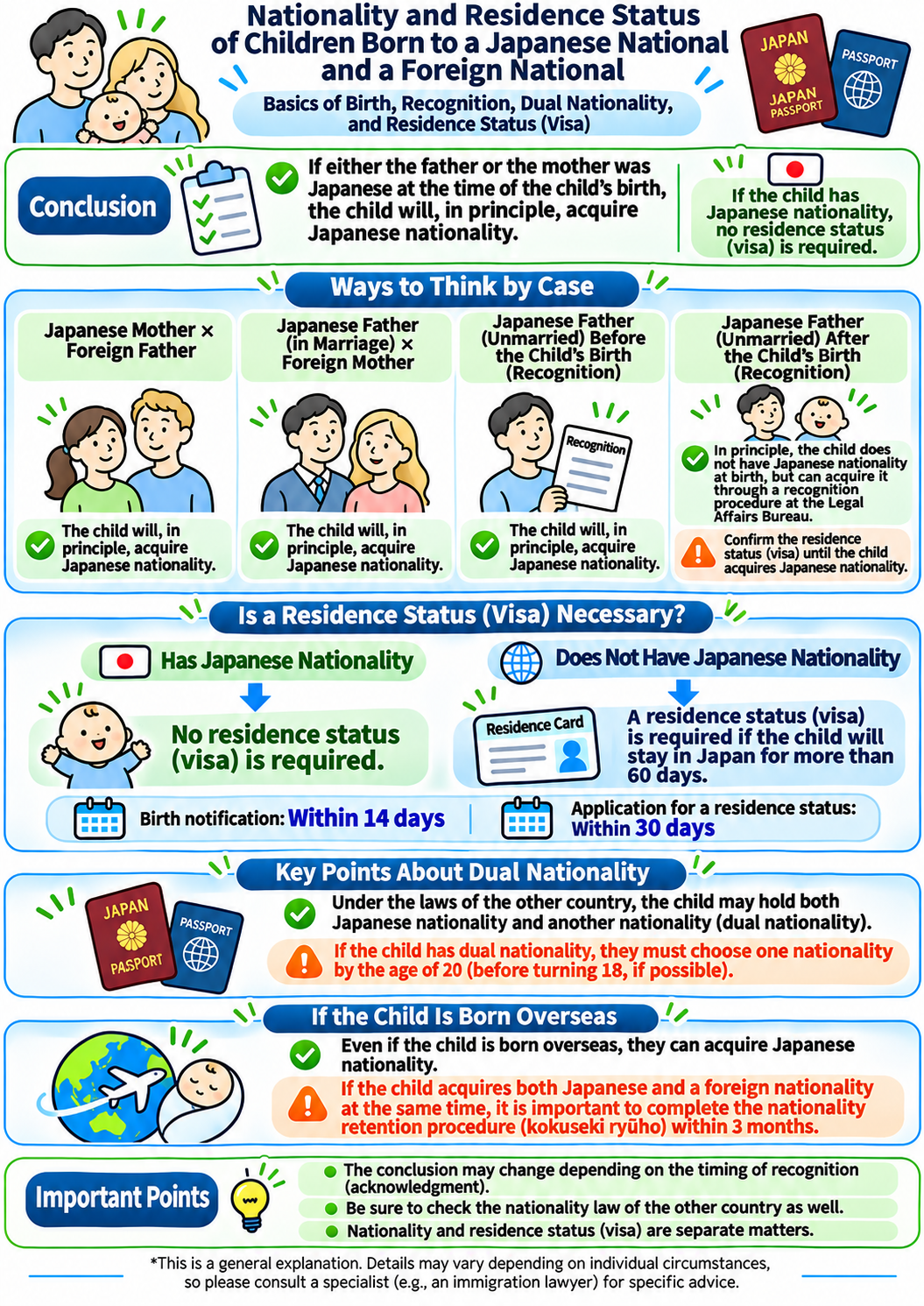
A child born to a Japanese national and a foreign national generally acquires Japanese nationality if the relevant requirements, including the legally recognized parent-child relationship at birth, are satisfied.
In some cases, the child may acquire both Japanese nationality and a foreign nationality.
However, if the Japanese father and foreign mother are not legally married, the method by which the child acquires Japanese nationality may depend on when the father acknowledges paternity.
Furthermore, if the child is born overseas, the parents must be particularly careful not to forget the nationality reservation procedure.
It is important to distinguish between nationality and residence status when considering the child’s legal position in Japan.
A child who has Japanese nationality does not need a status of residence to live in Japan.
On the other hand, a child who does not acquire Japanese nationality may need to obtain an appropriate residence status depending on their circumstances.
Consult an Administrative Scrivener About the Residence Status of Children Born to Japanese and Foreign Parents
At TORIKANI International Administrative Scrivener Corporation, we provide consultations concerning the residence status of foreign children and children born to Japanese and foreign parents.
We can assist with situations such as:
- “I am not married to my child’s Japanese father, and I am concerned about my child’s nationality.”
- “I want to bring my child, who was born overseas, to Japan.”
- “I want to know which residence status my child may qualify for if they cannot acquire Japanese nationality.”
- “I need help understanding the relationship between nationality acquisition procedures and residence status applications.”
In these situations, we review factors such as the family’s nationalities, marital relationship, acknowledgment of paternity, and the child’s place of birth.
Based on the circumstances, we can explain the appropriate immigration procedures and possible residence status applications.
Please feel free to contact us.
References
- Ministry of Justice: Nationality Q&A
- Ministry of Justice: Procedures for Acquiring Japanese Nationality Under Article 3 of the Nationality Act
- Ministry of Justice: Choosing Japanese Nationality
- Ministry of Justice: Family Register Q&A on International Marriage and Births Overseas
- Immigration Services Agency of Japan: “Spouse or Child of Japanese National” Status of Residence
- Immigration Services Agency of Japan: Application for Permission to Acquire Status of Residence
- Childcare Support Website for Foreign Residents: Three Important Procedures When a Baby Is Born

If you have any questions or concerns, please feel free to contact us. We are here to help!
Contact Us
You can contact us through LINE, WeChat, WhatsApp, by telephone, or through our online inquiry form.
Please choose whichever method is most convenient for you. We look forward to hearing from you!